
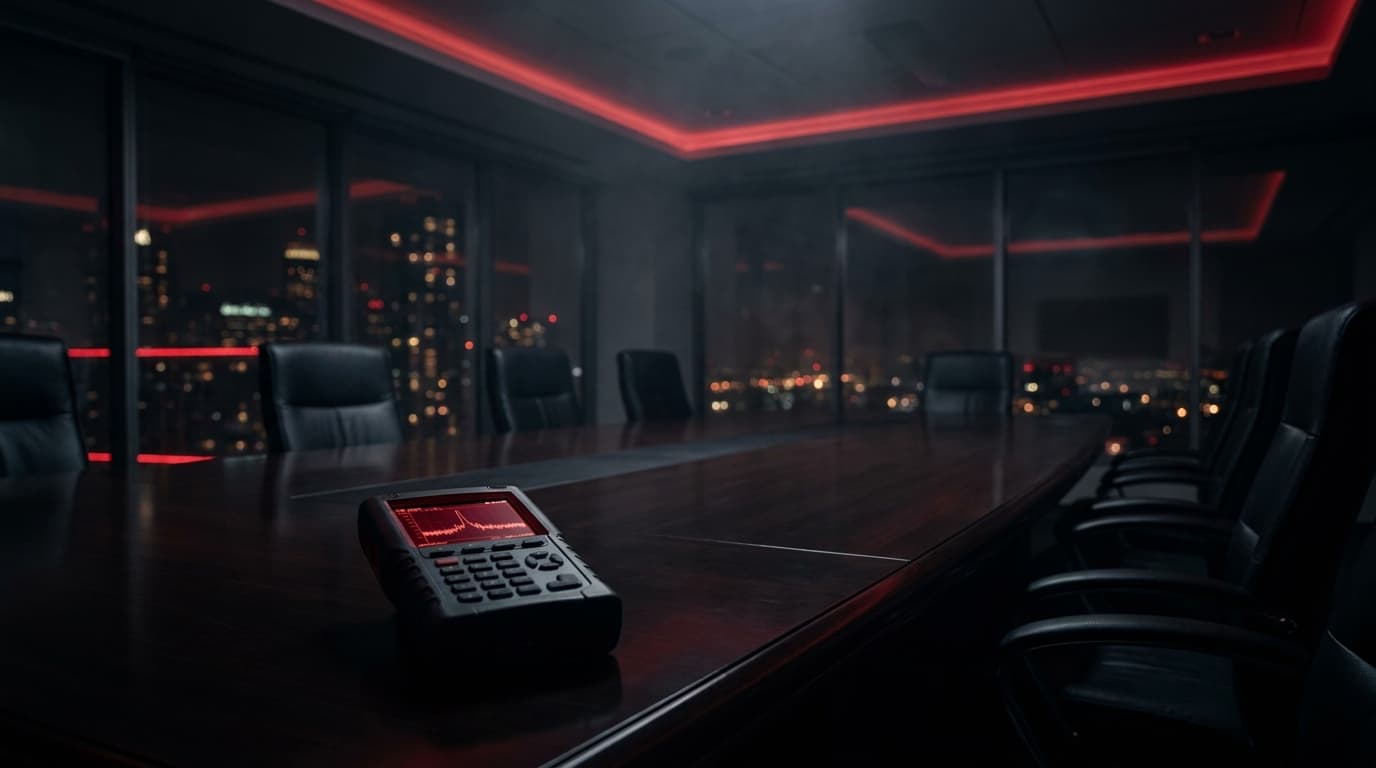
TSCM · Special operations
Technical surveillance countermeasures.
The last unencrypted channel is the spoken word.
Counter-surveillance sweeps for the rooms where your most valuable decisions are made — detecting, locating and neutralising hidden devices under total operational security.
Cyber Defense Division · discreet engagement
7
Sweep phases — RF, cable, optical, ultrasonic, physical, reporting
1 cm
Device localization precision (ultrasonic ranging)
Discreet
Team presents as facilities inspection — need-to-know only
The gap
You secured the network. Then you spoke in the room.
Every control you own protects data at rest and in transit. None of them protect the sentence said across a conference table — and that sentence is often the most valuable thing your organization owns that day. Three realities make the room a target:
The unguarded channel
You encrypt email, segment networks, and monitor endpoints — then say the quiet part out loud in a room that has never been checked. The spoken word is the last unencrypted channel.
The device that costs nothing
A pinhole camera, a VOX transmitter, a tapped line — hardware costs less than a laptop and needs no exploit. It just listens, and it's already inside the perimeter security worries about.
The compromise you'll never detect
A planted device leaves no log, no alert, no network trace. Without a physical sweep, the first sign of a leak is the deal that moved against you — after the fact.
Who commissions a sweep
Sovereign & investment — Funds structuring cross-border deals and board deliberations of diplomatic weight
Listed & M&A — Boards mid-transaction, where a leaked term is a market-moving event
Legal & litigation — Privileged strategy that must not reach the opposing side
Government & defence — Command and negotiation spaces where the adversary is funded
The target isn't you. It's the value of what you say.
What it finds
Every vector a room can hide.
Surveillance isn't one threat — it's five, across radio, wire, light, sound, and physical space. A real sweep covers all of them; a detector app covers none.
Wireless transmitters
Cellular 2G–5G, Wi-Fi, and A/V bugs across 10 MHz–12 GHz — including frequency-hopping and spread-spectrum.
Wired taps
Interception on LAN, telephone, and passive cabling; live-earth and live-neutral mains-carrier scanning.
Hidden cameras
Camera lenses located optically even when powered off, plus infrared and laser signal sources.
Dormant & VOX devices
Ultrasonic activation triggers voice-activated transmitters regardless of whether anyone is speaking.
Smart-device abuse
Smart TVs, CCTV, conferencing units, VoIP and desk phones — inspected including powered-off units.
Physical implants
An exhaustive hands-on search of fixtures, voids, furniture, and outlets that no instrument replaces.
The sweep
Seven phases. Every finding, evidenced.
Instrumented detection and disciplined physical search, executed in sequence — each phase produces a documented output that feeds the final report.
Pre-sweep planning
Threat and vulnerability assessment, floor-plan review, RF baseline survey — and OPSEC planning for the engagement itself.
Threat modelRadio-frequency sweep
Detection of cellular, Wi-Fi, and A/V transmissions across 10 MHz–12 GHz, with directional localization.
Intelligent RF probeCable & data-line inspection
Tracing to identify taps on LAN, telephone, and passive network cabling — the wired vectors RF misses.
Cable analyserOptical & infrared sweep
Camera lenses located active or dormant, plus infrared and laser signal sources.
IR / laser / camera probeUltrasonic & precision location
Triggers VOX transmitters regardless of ambient conversation and localizes devices to within 1 cm.
Sonic & ranging probePhysical inspection & evidence
Signal evidence logged, then an exhaustive physical search of fixtures, voids, and furniture.
Data logger + visualReporting & debrief
Findings consolidated into technical and executive reports; chain-of-custody maintained; verbal debrief on-site.
Dual-trackThe instruments behind the sweep
These phases run on professional-grade detection hardware — the same M7 multi-detection class Zentara fields on every engagement, and is preparing to offer for direct purchase. See the equipment →
Risk tiering
Depth allocated to risk.
A uniform sweep of every square metre wastes effort where it isn't needed and thins it where it is. Inspection depth is tiered to the sensitivity of what happens in each space.
T1 · Critical
Board & management rooms, meeting rooms, executive/VIP spaces, chief-legal office
Depth: Full six-discipline sweep · non-linear junction detection (NLJD) · dedicated AV and telephone-line tracing
T2 · Sensitive
Director offices, secretarial area, reception, staff clusters adjacent to leadership
Depth: RF, physical, and optical inspection · dedicated check of telephone and network points
T3 · Support & common
Open staff areas, pantry, restrooms, lift lobby, stairwells, corridors
Depth: RF and optical scanning · spot checks at common fixtures
Fixture-level checks across all tiers — smoke detectors · light fittings · HVAC vents · outlets · phones · teleconferencing · picture frames · USB chargers · ceiling & wall voids
Operational security
A sweep no one knows happened.
The engagement protects its own confidentiality as carefully as it protects yours — because a sweep everyone knows about is a sweep the planter can plan around.
Facilities cover
On site, the team presents as a facilities inspection crew. No reference to TSCM or counter-surveillance is made in front of staff or visitors.
Need-to-know only
Knowledge of the engagement is restricted to the people who must authorize it — typically the board and senior management, no wider.
Weekend windows
Sweeps run outside office hours to minimize disruption and protect the confidentiality of the engagement itself.
Leave-in-place protocol
If a device is found, it is left in place and the area secured — you are notified before any further action, so the finder never tips off the planter.
The deliverable
A verdict you can hold — and defend.
Every inspected point is recorded, clean or not. The report is a security baseline; where it matters, it's evidence.
Board & management · need-to-know
Counter-Surveillance Sweep — Executive Floor
Prepared for: · 2 floors · ±3,912 m²
Sweep result — by tier
Evidence appended
RF spectrum logs · cable-trace results · photographic record of every inspection point · fixture checklist per room
Verbal debrief delivered on site · executive briefing on request
Clean is a finding too
Every inspected point is recorded, not just the hits — so the report is a defensible baseline, not a list of problems.
Two audiences, two tracks
A technical record for the security team; an executive summary for the board, briefed in person if findings warrant.
Evidence-grade
RF logs, cable traces, and photographs behind every line — the report holds up as documentation, not just reassurance.
A baseline you can defend. On a cadence.
A discreet first conversation
No forms in front of your staff. Just a quiet call.
A short, confidential consultation scopes the floor, the tiers, and the window — under the same need-to-know discipline as the sweep itself. Most engagements start as one baseline and become an annual program.
After the sweep
A sweep is a moment. A room stays a target.
The room is guaranteed clean the moment the team leaves it — and no longer. So a sweep is the first move in a lifecycle: detect, then harden, then protect.
Counter-Surveillance Hardening engineers the room so surveillance can't work in the first place — signal, sound, emanation, and access, closed by design. And the GT-ZERO series holds the line between visits, masking any recorder that does appear.

Persistent protection
GT-ZERO
360° acoustic protection · 2 m radius · always on
Track record
Sweeps proposed and delivered for sovereign wealth institutions and corporate boards in Jakarta.
Engagements of this class are delivered under strict confidentiality — client names and findings are discussed only within a need-to-know group.
Build the program
Pairs well with
Counter-Surveillance Hardening
A sweep proves the room is clean today; hardening makes surveillance fail by design, so it stays clean between sweeps.
Corporate Investigations
A sweep finds the device; an investigation finds the person. When a bug points to an insider, the investigations team takes it from there.
Secure Data Center Design
For facilities that hold classified conversations by design, TSCM discipline is built into the architecture — not bolted on after.
FAQ
Common questions
Straight answers. If yours isn't here, ask us directly — discreetly.
A sweep detects, locates, and documents hidden interception devices: wireless microphones and A/V bugs, pinhole cameras (even powered off), telephone and network line taps, mains-carrier taps, and dormant recorders. If a live device is found, we do not remove it on the spot — that would alert whoever planted it. Under counter-intelligence protocol we leave it in place, secure the area, preserve chain of custody, and notify your need-to-know group before any further step. What you do next — feed it, remove it, or investigate the source — becomes a deliberate decision, not a reflex.
The room has been listening. Find out to whom.
A confidential, need-to-know consultation — the seven-phase sweep, tiered to your floor, run without a soul on staff the wiser. Start the quiet conversation.