A security dashboard with no alerts can mean one of two things. Either nothing is attacking you, or something is, and your detections never noticed. Most teams read silence as safety. Our testing suggests that is the more dangerous assumption.
When Picus Security ran more than 338 million attack simulations in the first half of 2026, 58% of those attacks were written to the logs, yet only 14% ever triggered an alert. Fewer than one in seven attacks were noticed, even though the evidence was already sitting in the system. The gap between what a SIEM records and what it surfaces is where most intrusions now live.
This article sets out why detections fail without raising an error, what we found when we tested detection rules against real attack evidence, how the same pattern appears in Indonesia at national scale, and what a security team can do about it over the next 90 days.
The Threat Moved to Valid Logins
The reason the gap matters more each year is that attackers have stopped breaking in and started logging in. The Verizon 2026 Data Breach Investigations Report found that 39% of breaches involve credential abuse somewhere in the attack chain. Among ransomware victims, 73% had an infostealer infection or a credential leak in the year before the attack, and half of those leaks happened within 95 days of it.
There is no malware to match and no exploit to flag. A valid account signs in and does the work, and signature-based controls stay silent because nothing technically malicious happened. To a SIEM, an attacker using stolen credentials and legitimate remote-access tools looks like an administrator doing their job.
Why Detections Fail Quietly
For an attack to be caught, a signal has to survive five stages. It can die at any one of them, and the first four fail without producing a single error. This builds on the Funnel of Fidelity described by Jared Atkinson at SpecterOps, focused on the stages where a signal goes silent.
Stage | The question it answers | It dies when |
1. Logged | Did the event reach the SIEM? | A source stops sending |
2. Parsed | Are the fields the rule needs present? | A field mapping changes |
3. Matched | Does the rule logic fire on the real behaviour? | The logic misreads the behaviour |
4. Alerted | Did it reach a person's queue? | A rule is disabled or suppressed |
5. Acted | Did someone respond in time? | The alert drowns in noise |
Because stages 1 to 4 fail without any error, "we have no alerts" and "we are not being attacked" are not the same statement. Only a test that walks a real technique through all five stages shows where a detection actually stops.
What We Tested and What We Found
We wanted to move past counting rules and actually test them. Using public data only, we took 470 real attack logs published by SigmaHQ, scoped to 191 attacker behaviours used by Lumma Stealer, LockBit 3.0 and RansomHub per MITRE ATT&CK, and ran them through the same open-source checker that SigmaHQ uses in its own test pipeline. The work is fully reproducible and used no production or customer data. We asked two questions.
Experiment | What we asked | What we found |
1. AI-written rules | Do detection rules written by AI actually fire on real attack evidence? | Eight AI models each wrote the same 191 rules. For a typical model, about 1 in 4 passed validation and never fired on the real attack log (ranging from 12% to 40% across models). Seven behaviours were caught by no model at all, and nine rules flipped result when the same model was given the same prompt twice. |
2. One missing field | What happens when a single log field stops arriving? | 235 of 444 proven rules (53%) depend on one field, CommandLine. When it stopped arriving, 95% of those rules went silent. For some other fields, 100% of the rules that relied on them went silent. The detection engine raised zero errors. |
The lesson from both experiments is the same. A rule that passes validation is not a rule that works, and a rule that worked yesterday can go silent today without anyone being told. Rules are cheap to produce. Proof that they fire is the expensive part, and it is the part most teams skip.
Indonesia Sees The Same Pattern At National Scale
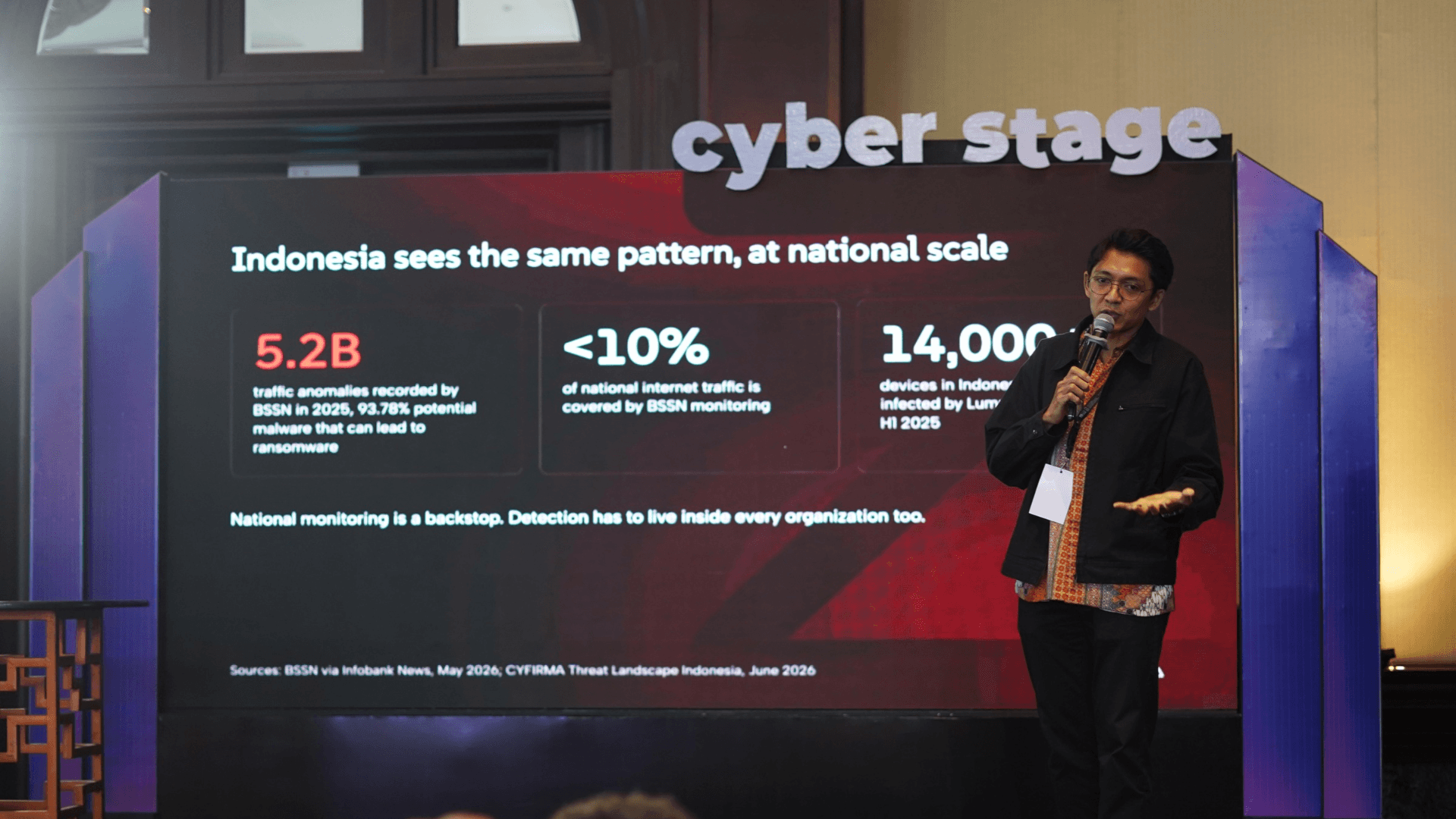
This is not only a global-industry problem. In 2025, BSSN recorded 5.2 billion traffic anomalies, of which 93.78% were potential malware that can lead to ransomware, according to figures reported by Infobank News. At the same time, national monitoring covers less than 10% of Indonesia's internet traffic, and CYFIRMA reported that more than 14,000 devices in Indonesia were infected by the Lumma Stealer infostealer in the first half of 2025.
National monitoring is a backstop, not a substitute. The same credential-driven, quietly-missed intrusions that the global data describes are already here, and detection has to live inside each organisation, not only at the national gateway.
Building Detections You Can Trust
The fix is not more rules. It is proving that the rules you already have actually fire, and treating each detection like code rather than a one-time setting. In practice that means every detection carries six things: version control, an ATT&CK mapping, a named owner who is a person rather than a shared inbox, a test case that proves it fires, a visible last-tested date, and a record of its known false positives. A rule without a test and an owner is a guess.
Validation then has to be continuous, because a detection breaks whenever the data around it changes. Test every new or changed rule before it goes live, test again after any change to parsers, agents or the SIEM itself, and run scheduled tests for your priority techniques.
This runs on public tools: MITRE ATT&CK as the map of techniques, Sigma for portable detection rules, and Atomic Red Team for small, safe tests. Purple teaming makes it routine, with one side running the technique and the other confirming the alert, together.
AI has a place in this, as an assistant and not an author. It is genuinely useful for drafting Sigma rules from threat reports, translating rules between query languages, and summarising alerts for the analyst on shift.
But given that 12% to 40% of AI-written rules in our test passed validation and never fired, every AI-drafted rule needs a test before it goes live, a human who reviews and owns it, and the same version control as any other rule. Speed without testing only adds to the pile of rules nobody has checked.
Where to Start: The Next 90 Days
None of this requires new tools to begin. Most of it runs on what you already have.
Window | Goal | What to do |
First 30 days | See clearly | Inventory log sources, turn on alerts for silent sources, and pick 10 to 20 priority techniques. |
By 60 days | Prove it | Write or tune rules for those techniques, give each an owner and a test, and run the first validation round. |
By 90 days | Keep it true | Schedule recurring tests, re-test after every change, and report proven coverage to leadership. |
If you want a sharper starting point, four questions will tell you where you stand: When was each critical rule last tested against a real simulation? What share of your log sources actually feed a detection? If a log source stopped sending today, how soon would you know? And which common attacker techniques would you miss right now?
Prove Your Detections Before An Attacker Tests Them For You
Logged is not the same as seen. A SIEM that is quiet because every detection has been tested and proven is a very different thing from a SIEM that is quiet because its signals are dying somewhere between the log and the alert, and from the dashboard the two look identical.
Zentara's Managed SOC is built on this principle. We monitor your environment around the clock, map detections to the techniques that matter to you, and validate continuously that those detections fire against real attack behaviour, so coverage is something we can prove rather than assume.
If you want to know whether your detections would catch a real attack today, contact our team. We will walk you through a detection validation review and show you exactly where your signals stand.
Frequently Asked Questions
1. What does it mean that an attack was "logged but not alerted"?
It means the evidence of the attack reached your SIEM and was written to the logs, but no detection rule turned that evidence into an alert anyone would see. The data was there; nobody was told.
2. Why would a detection rule stop working without raising an error?
A detection has to survive five stages: logged, parsed, matched, alerted, and acted. The first four can fail silently, no error raised, when a log source stops sending, a field mapping changes, or a rule is disabled. In our testing, one missing log field silenced 95% of the rules that relied on it, with zero errors.
3. What is detection validation?
Detection validation means testing a rule against real attack behaviour to confirm it actually fires, instead of assuming it works because it was written or passed a syntax check. It pairs a safe simulation of a technique with a check that the expected alert appeared.
4. Can AI write detection rules for us?
AI is useful for drafting rules, translating them between query languages, and summarising alerts, but it should assist, not decide. In our test, about one in four AI-written rules passed validation and never fired. Every AI-drafted rule still needs a test, a human owner, and version control before it goes live.
5. How often should detections be tested?
Test every new or changed rule before it goes live, test again after any change to parsers, agents, or the SIEM, and run scheduled tests for your priority techniques. A detection breaks whenever the data around it changes, so validation has to be continuous rather than a one-time setup.
6. What tools do we need to start?
Most of it runs on public, free tools: MITRE ATT&CK as the map of attacker techniques, Sigma for portable detection rules, and Atomic Red Team for small, safe tests. Purple teaming makes validation routine. You can begin with the SIEM and log sources you already have.

Written by
Arasy is a SOC Engineer at Zentara who moved into cybersecurity from software engineering. He specializes in threat intelligence, deception technologies, and security architecture, building honeypots and intelligence integrations for high-fidelity detection. He also runs the TryHards Community and teaches aspiring practitioners.