Running security around the clock is harder than most organisations expect. Threats don’t keep office hours, alerts pile up by the thousand, and the skilled people needed to make sense of it all are scarce and expensive.
A Managed SOC is how many organisations solve that problem without building an entire security operation from scratch.
This guide explains what a Managed SOC is, what it actually does day to day, where it helps, where it falls short, and how to choose a provider that fits. The aim is to give you a clear, honest picture so you can decide whether it’s the right move for your organisation.
What Is a Managed SOC?
A SOC (Security Operations Center) is the team, tools, and processes that watch an organisation’s systems for cyber threats and respond when something goes wrong. A Managed SOC is that same function, run for you by an outside provider rather than built and staffed in-house.
Instead of hiring a team of analysts, buying the monitoring tools, and running a 24/7 operation yourself, you partner with a provider who already has all of that.
Their analysts watch your systems, investigate the alerts that matter, and help you respond to real incidents. You get the capability of a full security operations centre without carrying the full cost and complexity of building one.
It isn’t a single product you install, and it isn’t a replacement for caring about security internally. It’s an ongoing partnership where a specialised team takes on the heavy, continuous work of detection and response, while you stay in control of the decisions that matter to your business.
How a Managed SOC Works
A Managed SOC sits between your systems and the threats trying to reach them. It watches everything that happens and steps in when needed, running the same loop over and over, day and night. Here’s how that loop works.
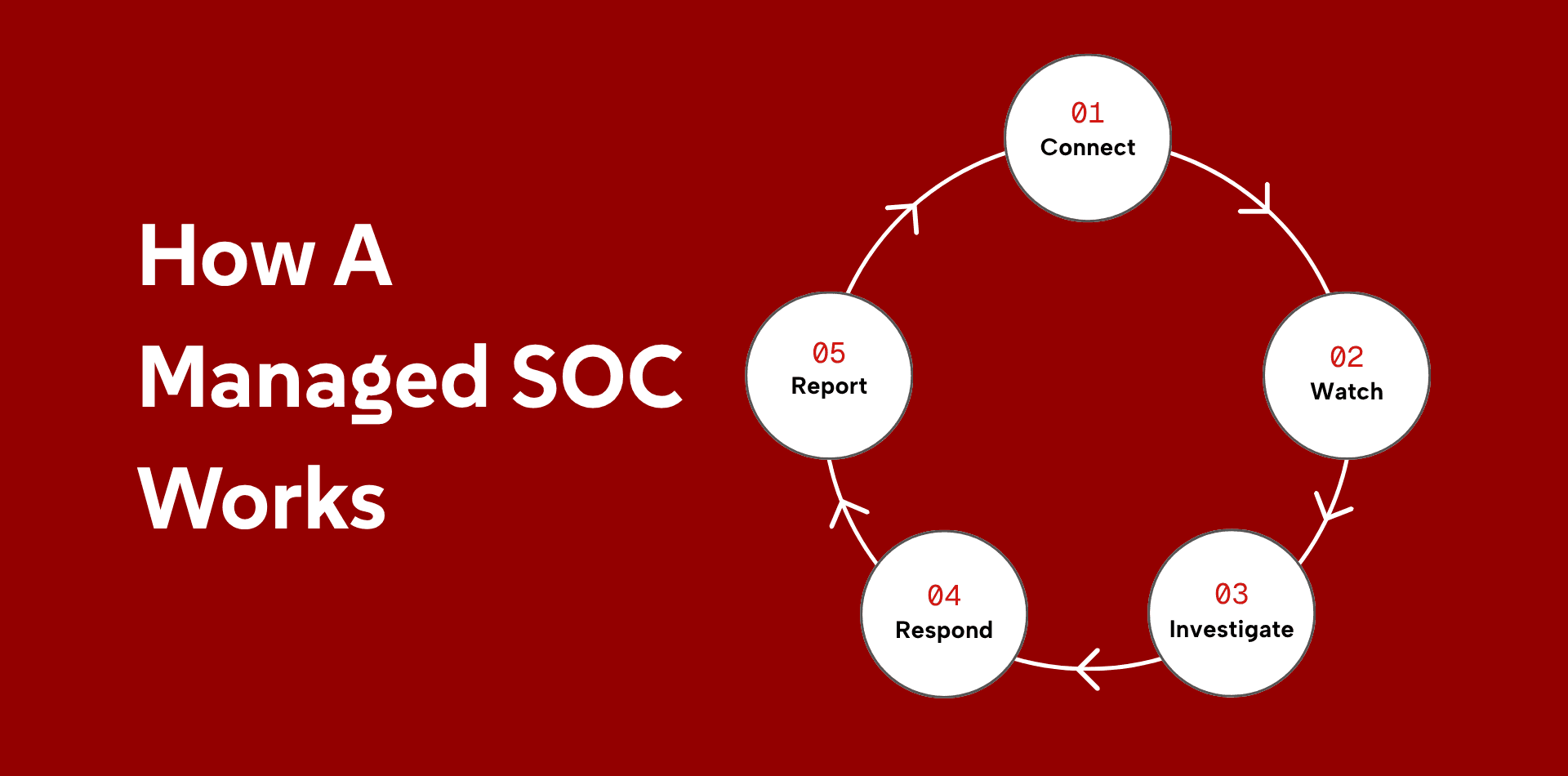
- Connect. The provider plugs into your environment and starts gathering signals from across your systems. All of it flows into the tools the provider uses to spot trouble.
- Watch. Those tools and the provider’s analysts scan that activity for anything suspicious. Modern setups use automation and AI to handle the sheer volume, because the numbers are punishing. Sorting the real threats from the noise is the core of the work.
- Investigate. When something genuine turns up, the provider digs in to understand what’s happening, how serious it is, and what to do about it.
- Respond. For clear, urgent threats, they act fast, isolating an infected device or blocking a malicious login, often within minutes. For anything that needs a business decision, they bring it to you with the context you need to make the call.
- Report. Finally, they tell you what they saw, what they did, and what it means for your security over time.
Then the loop starts again. Watch, investigate, respond, report, without pause, around the clock.
Core Services of a Managed SOC
Managed SOC covers a bundle of related services. Here’s what a strong one actually delivers.
1. 24/7 Monitoring and Threat Detection
The provider watches your systems every hour of every day, including nights, weekends, and holidays, because attackers deliberately strike when they expect no one to be watching.
Continuous monitoring means a threat at 3 AM on a public holiday gets the same attention as one at midday on a Tuesday.
2. Incident Triage and Alert Analysis
Not every alert is an emergency, and most aren’t. Triage is the work of sorting through the flood of alerts, separating genuine threats from false alarms, and ranking what’s left by urgency.
This is one of the most valuable things a Managed SOC does, because it spares your team from drowning in noise and ensures the real problems get attention fast.
3. Threat Hunting
Threat hunting is the proactive search for attackers who may already be inside but haven’t tripped any alerts yet, the quiet intruder moving carefully to avoid detection. Skilled hunters look for the subtle traces these attackers leave, catching them before they cause damage.
4. Incident Response
When a real attack is confirmed, response is what contains it. The provider takes or guides the steps that stop the threat spreading: isolating affected systems, shutting down compromised accounts, and removing the attacker’s foothold. Speed here matters enormously, because the faster an incident is contained, the less damage it does.
5. Compliance and Reporting Support
Many organisations face rules that require them to monitor their systems, keep records, and report incidents within set timeframes. A Managed SOC produces the logs, evidence, and reports that prove you’re meeting these obligations, which is invaluable when a regulator or auditor comes asking.
6. Vulnerability Management
Beyond watching for active threats, a Managed SOC helps you find and fix the weaknesses attackers could exploit. This means identifying unpatched software, weak configurations, and other gaps, then helping you prioritise which to fix first based on which pose the real risk.
Benefits of a Managed SOC for Organisations
Why do organisations choose this route? The benefits come down to lowering risk, controlling cost, and gaining capability they couldn’t easily build alone.
1. Reduced business risk from cyber incidents
The core benefit is simpler and safer operations. Continuous monitoring and fast response mean threats are caught and contained before they become full breaches. This matters financially.
IBM’s 2025 Cost of a Data Breach Report put the global average cost of a breach at USD 4.44 million, and found that faster detection and containment was one of the biggest factors in bringing that cost down.
2. Lower total cost of security operations
Building a 24/7 SOC in-house is expensive in a way that surprises many organisations. Covering every hour of the week typically requires a team of seven to twelve analysts.
Analysis from Security Operations Cost puts the staffing bill at USD 1 million to over USD 2 million a year, making up the majority of the total cost. A Managed SOC turns that large, fixed investment into a predictable subscription, usually at a fraction of the cost of building the same capability internally.
3. Faster time to maturity
Building security operations from nothing takes months: planning, buying and integrating tools, defining processes, and hiring. A Managed SOC provider already has all of that running. You gain mature, capable security operations in weeks rather than the year or more it can take to build your own.
4. Stronger compliance and audit posture
The monitoring, logging, and reporting that a Managed SOC provides are exactly what compliance frameworks ask for. Having a provider continuously generate this evidence makes audits smoother and helps you meet obligations like incident reporting deadlines that an understaffed internal team would struggle to hit.
5. Scalability without hiring
As your organisation grows, so does the work of securing it. With an in-house team, growth means more hiring, in a market where talent is scarce. ISC2’s workforce research puts the global cybersecurity shortage at more than four million unfilled roles, which makes hiring slow and costly.
A Managed SOC scales with you without forcing you to compete for hard-to-find analysts every time you expand.
Managed SOC vs MDR vs MSSP
These three terms get used interchangeably, but they mean different things, and the differences matter when you’re choosing. Here’s how they compare.
Type | Managed SOC | MDR | MSSP |
Full name | Managed Security Operations Center | Managed Detection and Response | Managed Security Service Provider |
Focus | Runs your whole security operation | Finds and actively stop threats | Manages and maintains your security tools |
Who investigates alerts | The provider | The provider | Usually your team |
Who responds to alerts | The provider, working with you | The provider contains the threat directly | Your team acts, the MSSP alerts you |
Threat hunting | Included | Core part of the service | Generally not included |
Cost basis | Bundled as a full-service subscription | Premium (priced for expertise and response) | Lower (priced per device or user) |
Best for | Organisations wanting complete security operations without building one | Organisations needing real response but no internal team | Organisations wanting wide and affordable management existing tools |
Limitation | Costs more than single-function services | Narrower scope than a full SOC | You still own the response |
In-House SOC vs Managed SOC
Should you build your own or partner with a provider? Both are valid; the right choice depends on your size, budget, and needs. Here’s the honest comparison.
Aspect | In-House SOC | Managed SOC |
Upfront cost | High: tools, infrastructure, and hiring before you see value | Low: subscription starts quickly |
Ongoing cost | Very high: USD 1-2 million + a year in staffing for 24/7 coverage | Predictable monthly or annual fee |
Time to running | Months to over a year | Weeks |
Staffing burden | You recruit and retain scarce analysts in a tight market | The provider handles all staffing |
24/7 coverage | Hard and costly to sustain, needs 7-12 analysts | Built in |
Control and visibility | Full, direct control | Shared, depends on the provider’s transparency |
Business context | Deep knowledge of your own systems | Provider must learn your environment |
Also Read: Managed SOC vs SOC as a Service: The Technical Divide That Defines Modern Cyber Defense
Challenges of Adopting a Managed SOC
A Managed SOC is not a magic fix, and knowing its challenges upfront helps you choose a provider who has already solved them. Each of these is manageable with the right partner and a clear agreement.
1. Maintaining visibility into your own security
When an outside team runs your monitoring, you can feel further from your own security, relying on the provider to tell you what’s happening rather than seeing it directly. The way around this is to agree on the visibility you’ll get before you sign.
A strong provider makes its work transparent through clear dashboards and regular reporting, so you end up with more insight into your security posture than you had before, not less.
2. Data residency and compliance
A Managed SOC processes a significant amount of your data, and where it’s stored and handled carries legal weight. In Indonesia, where rules around personal and regulated data are tightening, this matters. Ask whether a provider keeps your data in-country and handles it in line with local law.
A provider that understands the regional regulatory landscape turns this from a risk into an advantage
3. Onboarding and integration
Getting a Managed SOC running takes coordinated work on both sides, connecting to your systems, learning your environment, and tuning detection to your normal patterns. Understand a provider’s onboarding process before you commit.
An experienced provider has done this many times and makes the setup efficient rather than disruptive, which shapes how well the service performs afterward.
4. A clear responsibility split
The most common source of trouble is unclear boundaries, when both sides assume the other is handling something and it falls through the cracks. Settle who does what before you start, and get it in writing.
A capable provider brings this structure from day one, defining exactly what they handle, what stays with your team, and how decisions get made when speed matters.
How to Choose the Right Provider
Not all providers are equal, and the wrong fit can leave gaps an attacker will find. Here’s what to weigh.
1. Coverage and Service Level Agreements (SLAs)
Look closely at what’s actually covered and how fast the provider commits to responding. A Service Level Agreement (SLA) is the written promise of response times and service standards. Vague promises are a warning sign; clear, measurable commitments, like how quickly they’ll respond to a serious incident, are what you want.
2. Tool and Vendor Compatibility
Check whether the provider works with the security tools you already use, or expects you to replace them. A provider that integrates with your existing setup saves cost and disruption. One that forces a rip-and-replace adds both.
3. Data Residency and Compliance Alignment
Confirm where your data will live and that the provider understands the rules you operate under. For an Indonesian organisation, a provider who knows local regulations and can keep data in-country is far easier to work with than one who treats compliance as an afterthought.
4. Threat Intelligence and Expertise
The value of a Managed SOC rests on the skill of its people and the quality of its threat knowledge. Ask about the experience of their analysts, how they stay current on new threats, and whether they understand the kinds of attacks that target organisations like yours.
5. Reporting and Transparency
Because you’re trusting an outside team, clear reporting is how you stay informed and in control. Good providers give you regular, understandable reports and dashboards, not a black box. Ask to see a sample report before committing.
6. Regional Presence and Local Support
A provider with people in your region understands your regulatory environment, the threats common to your market, and can support you in your language and time zone. For an organisation in Indonesia, local presence means a partner who understands the specific landscape you operate in, not a distant call centre.
Building Stronger Security With a Managed SOC
The case for a Managed SOC is simple: defending systems around the clock takes more people, tools, and expertise than most organisations can build alone. A Managed SOC gives you that capability as a partnership, without the cost of building it yourself.
There’s no single right answer. Some organisations should build in-house, many should partner, and a growing number do both. What matters is matching the model to your size, your risk, and the rules you work under.
It’s usually worth a conversation when a few things sound familiar: no one watches your systems after hours, alerts pile up faster than your team can clear them, security hiring is a constant struggle, or you’re not sure how fast you’d catch a real attack.
If that fits, Zentara can help. We watch your systems day and night, respond to real threats instead of just forwarding alerts, keep your data in-country and aligned with Indonesian rules, and work with the tools you already have.
Talk to the Zentara team and we’ll show you where your coverage holds and where it doesn’t.
Frequently Asked Questions
1. What is the difference between a SOC and a managed SOC?
A SOC is the security monitoring and response function itself. A Managed SOC is that same function run for you by an outside provider instead of an in-house team. Same work, different owner: you get the capability without hiring the people or buying the tools.
2. How much does a managed SOC cost?
Far less than building one in-house, where 24/7 staffing alone can run USD 1-2 million a year. Smaller organisations often get meaningful coverage for a few thousand US dollars a month, usually as a predictable subscription. For an accurate figure, ask providers to quote against your specific environment.
3. Is a managed SOC right for small businesses?
Often, yes. Small businesses rarely have the budget or people to run security around the clock, yet they’re frequent targets precisely because attackers expect weaker defences. A Managed SOC gives them enterprise-grade monitoring and response at a cost that fits.
4. Can a managed SOC work with our existing security tools?
Usually, yes, and it’s worth confirming early. Many providers integrate with the tools you already have, saving costly replacements. Some prefer their own, so check before signing.
5. What is the difference between managed SOC and MDR?
MDR focuses on detecting and actively stopping threats, including threat hunting and containment. A Managed SOC is broader, covering monitoring, detection, response, compliance, and reporting, often with MDR-style response included. Think focused capability (MDR) versus complete operations function (Managed SOC). The terms overlap, so always check what a provider actually includes.
Written by
Marsha Widagdo is a seasoned cybersecurity professional with over seven years of experience spanning banking, government, and diverse industries. Marsha’s expertise lies in building resilient blue teams, optimizing advanced cyber defense technologies, and implementing global security frameworks. As Head of the Blue Team (SOC) at ZENTARA, Marsha focuses on safeguarding critical infrastructure.