
Security operations · Proactive detection
Threat hunting.
Assume breach. Go find it.
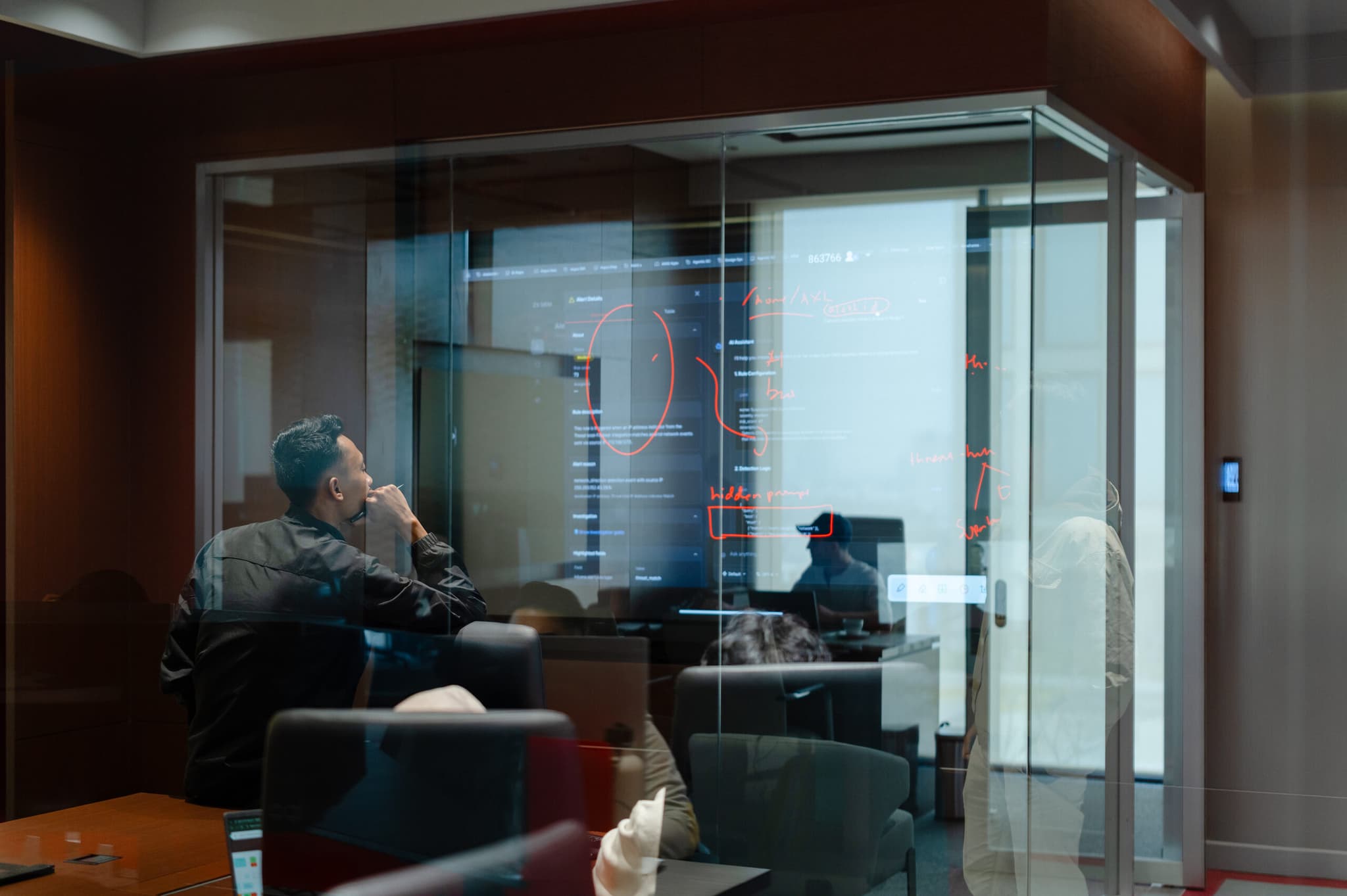
Hypothesis-driven hunts by Zentara's SOC team — AI-augmented, mapped to MITRE ATT&CK and run in your own telemetry — for the adversary who never triggers an alert.
5–10
Hypotheses hunted and adjudicated per cycle
≥30%
Dwell-time reduction target in the first cycle
40–60
Queries & playbooks handed over across a year



The gap
Alerts wait. Hunters look.
Industry dwell-time studies put the gap between intrusion and discovery in months, not minutes — because the intruders worth worrying about are engineered not to trip an alert.
The alert threshold
Automated detection fires on what it already knows. Novel tradecraft, living-off-the-land techniques, and slow-moving campaigns sit below it — indefinitely.
The quiet adversary
APTs, insiders, and lateral movement are engineered to look like normal operations. No alert means nothing — absence of evidence isn't evidence of absence.
The unprovable negative
When the board or the regulator asks 'are we compromised?', a quiet dashboard isn't an answer. Only a documented search is.
The three questions a hunt asks
“If someone were already inside, where would they be standing?”
Hypotheses from your crown jewels and threat profile
“What would their traffic look like in our telemetry?”
Custom queries against your SIEM and EDR — not vendor defaults
“Can we prove what we found — and what we didn't?”
Confidence-rated findings with evidence, ATT&CK-mapped
Absence of alerts is not absence of adversaries.
The hunt loop
Five moves. Every cycle.
Hypothesis-driven and AI-augmented, following MITRE ATT&CK and the Pyramid of Pain — aimed at the indicators adversaries can't cheaply change.
Hypothesize
5–10 hypotheses per cycle, built from your industry threat profile, current intelligence, and what your estate actually holds — not a generic checklist.
Enrich
Telemetry collected and normalized from your logs, endpoints, network, and cloud. AI triage cuts the noise before a hunter spends a minute on it.
Hunt
Custom KQL and Sigma queries executed in your SIEM and EDR, correlated against live threat-intelligence feeds. Hunters drive; automation carries.
Validate & map
Every finding cross-verified, severity-scored, and mapped to MITRE ATT&CK. Hypotheses are adjudicated — validated, refuted, or carried forward. Refuted is a result too.
Hand over
Queries, condensed playbooks, and a debrief with the hunters. Findings feed detection engineering — each hunt hardens the next.
Accelerated by Agent ODYSSEY
Zentara hunts run with ODYSSEY's Threat Hunting agent in the loop — building hypothesis hunts from ATT&CK and logging every hunt to shared memory, so each cycle starts smarter than the last. See how the agent works →
What you get
Every hypothesis gets a verdict.
Validated, refuted, or carried forward — a hunt that finds nothing proves something. The report is written so an auditor, a director, or your next hire can retrace it.
Hypothesis register · Cycle Q3
Prepared for: · 214 GB telemetry · 31 days
Detection handover — Sigma (excerpt)
title: WMI Lateral Movement from Finance Subnet
status: experimental        # ZTR-TH-Q3-018
logsource:
  product: windows
  service: wmi
detection:
  selection:
    EventID: 5861
    SourceNetwork|startswith: '10.24.'
condition: selectionHunt reports
Executive summary plus the detailed report — every finding evidence-backed and ATT&CK-mapped, written to survive an audit.
10–20 custom queries per cycle
KQL and Sigma, written for your environment, handed over for internal reuse — 40–60 across a year.
Condensed playbooks
Replicable response playbooks for the scenarios that matter — ransomware precursors, insider risk, credential abuse.
The debrief
The hunters walk your team through what was found, what was ruled out, and what to watch next.
The hunt ends. The capability stays.
Cadence
Three tempos. One methodology.
Every tier runs the same hunt loop — the difference is how often it turns, and how much compounds.
Core
Quarterly hunts
Baseline assurance — a documented search each quarter with standard reporting.
- Quarterly hunt cycle
- Executive & detailed reports
- Query handover
Edge
Most chosenMonthly hunts
Continuous refinement — hypotheses compound month over month.
- Everything in Core
- Monthly hunt cycles
- Full playbook library
- Detection-engineering feedback loop
Apex
Weekly hunts
For institutions with mature security teams running their own SOC.
- Everything in Edge
- Weekly hunt tempo
- Integration with your SOC
- Standing quarterly support
Every tier opens with the same requirements workshop — scope and pricing are fixed there, in writing.
Start with one cycle
One hunt cycle. A verdict on every hypothesis.
Read-only access, thirty days of logs, and four to six weeks later you hold evidence-backed findings, custom queries, and playbooks your team keeps — whatever the hunt concludes.
Ground rules
What we need. What we won't do.
Hunting works on trust and telemetry. Both get defined before the first query runs.
Your platforms, not ours
We hunt in your SIEM and EDR through read-only access over secure VPN. Nothing to buy, nothing installed, nothing changed.
Thirty days of logs to start
The minimum telemetry for a meaningful first cycle. Thinner than that, and we'll say so — and scope honestly.
Hunting is not remediation
If a hunt surfaces a live intrusion, containment is your call — we escalate immediately with evidence, and IR engages under its own scope.
Weekly check-ins, no surprises
Progress updates every week of the cycle. The final report never contains a finding you're hearing about for the first time.
Build the program
Pairs well with
Managed SOC
Hunts are pulses; a SOC is the standing watch. Validated findings become detection rules your monitoring runs 24/7.
Incident Response & Digital Forensics
When a hunt finds a live intrusion, response takes over — containment, forensics, and chain-of-custody discipline, engaged on your approval.
VAPT — Vulnerability Assessment & Penetration Testing
Offensive findings are hunting fuel: the paths our red side proves become the hypotheses the hunt side chases.
FAQ
Common questions
Straight answers. If yours isn't here, ask us directly.
Monitoring answers 'did something we recognize just happen?' Hunting answers 'is something we don't recognize already here?' Alerts are reactive by design — they fire on known signatures and thresholds. A hunt starts from the assumption of breach and searches for the tradecraft that never trips an alert: living-off-the-land techniques, slow lateral movement, insider activity. The two are complementary — and validated hunt findings become new detections for the watch.
If someone is already inside, every quiet week compounds.
One cycle settles it — a documented search of your estate, a verdict on every hypothesis, and the queries to keep watching. Scope the first hunt.