
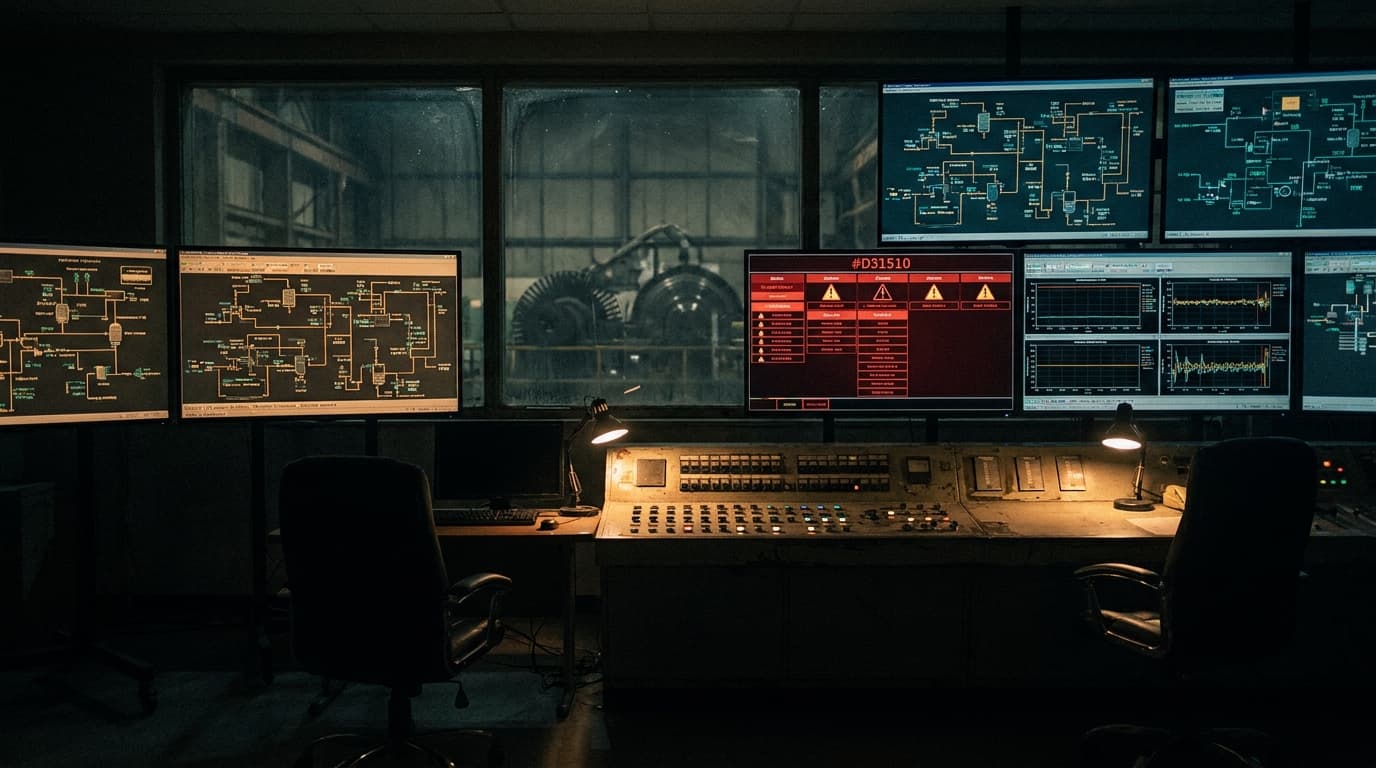
Critical infrastructure · OT security
SCADA & OT security.
When a breach breaks something physical.
Industrial control security for the estates Indonesia can't afford to lose — safety first, passively assessed and segmented to the standard the process demands.
Safety first
not confidentiality
The OT priority order inverts the IT one
Passive
only
Assessment that never risks a live process
62443
The zones-and-conduits standard we design to

The gap
Downtime here isn't a ticket. It's a blackout.
Indonesia runs on operational technology — the largest power grid in Southeast Asia, a sprawling oil and gas estate, water utilities, mines, and factories across the archipelago. Much of it runs control systems built when the network was a closed room. Now that room has doors, and IT security thinking makes three mistakes:
The IT playbook, misapplied
An active vulnerability scan that's routine on a laptop can crash a PLC that has run untouched for fifteen years. IT tools in an OT network don't just miss the risk — they become it.
The convergence blind spot
Every efficiency win that connects the plant floor to the business network is also a new path in. IT/OT convergence delivered the data and the exposure in the same cable.
The protocols that trust everyone
Modbus, DNP3, Profibus, OPC — engineered for reliability in a closed room, with no authentication and no encryption. On a reachable network, a command is a command, whoever sends it.
Cyber became kinetic — three proofs
Stuxnet
2010Proved malware can physically destroy centrifuges — cyber to kinetic, demonstrated.
Industroyer
2016Speaks grid protocols natively; tripped substations and cut power to a capital city.
TRITON
2017Targeted the safety instrumented system itself — the last line before catastrophe.
These weren't theory. They stopped turbines, tripped grids, and targeted the safety systems themselves.
Why OT is different
The priorities flip upside down.
In IT, you protect the data first. In OT, you keep the process running and people safe first — and everything about the security program has to change to match.
1. Confidentiality
Protect the data first
1. Availability & Safety
Keep the process running — and people alive
2. Integrity
Then trust the data
2. Integrity
Then trust the process control
3. Availability
Then keep it online
3. Confidentiality
Then protect the data
This is the whole discipline in one idea. A security measure that improves confidentiality but risks availability is a net loss in OT — and a scanner that could crash a controller is a threat, not a tool. Everything we do starts here.
The model
Six levels. One controlled boundary.
The Purdue model organizes an industrial estate into levels — and the discipline is keeping data flowing up while commands can't flow down. ISA/IEC 62443 turns those levels into enforceable zones and conduits.
ERP, business systems, internet — the world SCADA was never meant to touch.
The controlled crossing. Data brokers, jump hosts, and the conduit every packet must earn.
Historians, engineering workstations, and the SCADA servers that run the site.
HMIs and control servers — where operators see and steer the process.
PLCs, RTUs, and the safety instrumented systems that must never mis-fire.
Sensors and actuators — valves, pumps, breakers. Where cyber becomes kinetic.
How we work
First, do no harm.
An OT engagement is judged first on what it didn't disrupt. Four moves, every one designed around the live process.
Discover — passively
OT asset inventory built from network taps and span ports, never active scans. We learn the estate by listening, not probing — every device, protocol, and conversation, at zero process risk.
Assess by consequence
Not every vulnerability matters equally; the ones that could stop a turbine or open a valve do. We rank findings by physical consequence, the way ICS engineers actually triage risk.
Segment — zones & conduits
A Purdue-aligned architecture: security zones by function and criticality, controlled conduits between them, and the IT/OT boundary hardened so business convenience never reaches the process floor.
Monitor & rehearse
Detection that parses Modbus and DNP3, not just TCP — integrated with the SOC. Then a tabletop kill-chain exercise against your real process, run safely, so the response is muscle memory before it's needed.
Consequence-ranked findings
Prepared for: · 1,847 OT assets discovered
Ranked by physical consequence — not CVSS alone
Ranked by consequence
Findings sorted by what they could do to the process — a valve, a turbine, a trip — not by CVSS in isolation.
Mapped to zones
Every finding placed in the Purdue level and 62443 zone it lives in, so remediation is architectural, not whack-a-mole.
Safe to hand to engineers
Written for the control engineers who own the process, with remediation that respects change windows and vendor support.
Nothing scanned. Everything seen.
Start by listening
See your OT estate — without touching the process.
A passive assessment builds the asset inventory, maps the protocols, and ranks the real exposure — with not a single packet injected into your control network. The safest first step there is.
Who we serve
Indonesia's critical estates.
Every sector where a control-system failure has consequences beyond a balance sheet — which, in an industrial nation, is most of them.
Power & utilities
PLN-scaleGeneration, transmission, and distribution — where downtime is measured in megawatts and grid stability.
Oil, gas & petrochem
Pertamina-scaleUpstream, refining, and pipeline SCADA — where a manipulated setpoint has flammable consequences.
Water & wastewater
MunicipalTreatment and distribution control — public-health infrastructure with thin security budgets.
Mining & metals
MIND ID-scaleProcessing plants and haulage control across remote, converged OT estates.
Manufacturing
IndustrialDiscrete and process lines where a halted PLC is a stopped production floor.
Transport & ports
LogisticsRail signalling, port cranes, and logistics control — safety-critical, increasingly connected.
Track record
ISO 27001 assessment delivered for listed power-generation companies; cyber-risk briefings for national energy directorates.
Build the program
Pairs well with
Secure Data Center Design
OT facilities and the data centers behind them share a threat model. The sovereign-facility practice designs the estate around the process.
Managed SOC
OT detection needs a watch that speaks industrial protocols. The SOC ingests OT telemetry alongside IT — one floor, both estates.
Incident Response & Digital Forensics
When an OT incident hits, response has to protect the process before the evidence. IR engages with safety as the first priority.
FAQ
Common questions
Straight answers. If yours isn't here, ask us directly.
Because OT is unforgiving of the assumptions IT tools make. An active vulnerability scan — harmless against a server — can send malformed packets that crash a PLC controlling a live process, and a mandatory patch reboot can mean an unplanned plant shutdown. The priorities invert, too: IT optimizes for confidentiality, OT for availability and safety. Our entire method is built for that reality — passive discovery, consequence-driven ranking, and change windows that respect the process.
Related
More in Advisory & Compliance
The grid, the refinery, the water — they don't get a maintenance window for a breach.
Secure the process the way it has to be secured: safety first, passively assessed, segmented to standard. Start with a no-touch OT assessment.