

A strong security programme needs more than tools. It needs a structure that decides what to protect, in what order, and how to prove it works. The NIST Cybersecurity Framework gives organisations that structure, and it has become the most widely adopted cybersecurity framework in the world.
IDC estimates that more than half of Fortune 500 companies headquartered in the United States now use the NIST Cybersecurity Framework as their primary control framework.
Adoption is no longer limited to critical infrastructure or large enterprises. The latest version, CSF 2.0, was released in February 2024 by the National Institute of Standards and Technology and is designed for any organisation, of any size, in any sector.
This guide explains what the framework is, how it works, and how to put it into practice. We cover its history, the functions, the implementation tiers, how it aligns with other standards, and the challenges to expect along the way.
History of the NIST Cybersecurity Framework
The framework was created to solve a national security problem. By 2013, cyberattacks on critical infrastructure in the United States were rising fast, and there was no common language for managing cyber risk. Every sector had its own standards, and they rarely matched.
In February 2013, President Barack Obama signed Executive Order 13636, Improving Critical Infrastructure Cybersecurity. It directed the National Institute of Standards and Technology (NIST) to build a single, voluntary framework that any organisation could use to identify, assess, and manage cyber risk.
NIST has released three versions since then, each reflecting how cybersecurity has changed.
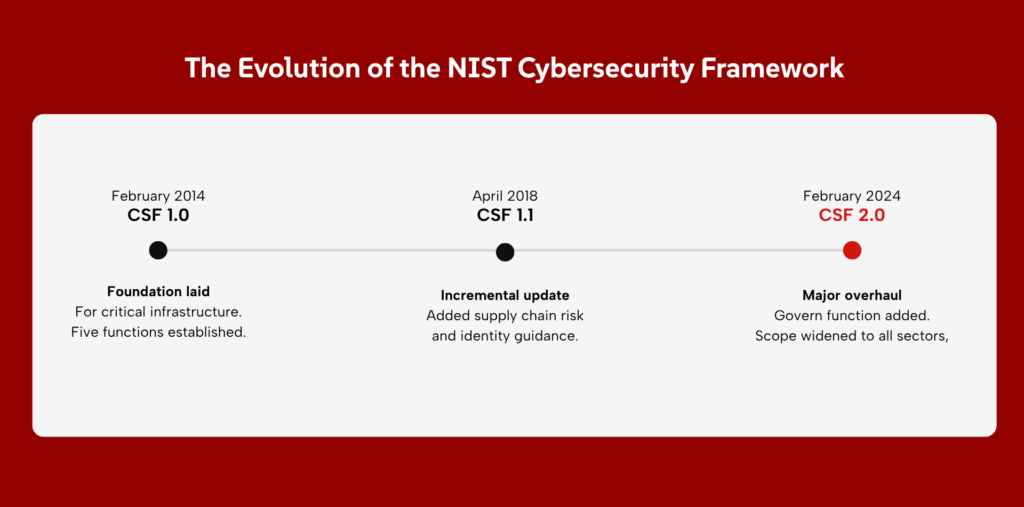
CSF 1.0 (2014)
The first version was published on 12 February 2014. It introduced the structure the framework still uses today: a core of high-level functions, broken down into categories and subcategories, with implementation tiers and profiles to help organisations measure where they stood.
CSF 1.0 was written for critical infrastructure operators (energy, finance, healthcare, telecoms), but it was quickly adopted far beyond that audience.
CSF 1.1 (2018)
Four years later, NIST released CSF 1.1 on 16 April 2018. The update was incremental, not radical. It clarified existing guidance, refined language around risk management, and added new sections on supply-chain risk and identity management. The five original functions, Identify, Protect, Detect, Respond, and Recover, stayed in place.
CSF 2.0 (2024)
On 26 February 2024, NIST released CSF 2.0, the first major overhaul in a decade. The changes reflect how cybersecurity has shifted from a technical issue into a board-level concern.
Three updates matter most:
- A new sixth function, Govern. Added to the original five, raising the total to six.
- Wider scope. The framework is no longer aimed only at critical infrastructure. It is built for any organisation, of any size, in any sector.
- Stronger emphasis on supply-chain risk and measurement. Categories and subcategories were reorganised to reflect modern risks, with around 20 new subcategories added.
Understanding the NIST Cybersecurity Framework
The NIST Cybersecurity Framework (CSF) is a voluntary, structured guide for managing cybersecurity risk.
It does not tell you which products to buy or which controls to install. Instead, it gives you a shared language and a logical structure for deciding what to protect, how to protect it, and how to measure whether it is working.
The framework is built from three main parts:
- The Core: a set of cybersecurity outcomes, grouped into functions, categories, and subcategories. The Core is where most day-to-day work lives. We cover each Function in detail later in this guide.
- Profiles: a snapshot of where your organisation is today, and where you want it to be. The gap between the two becomes your roadmap.
- Tiers: a way to describe how mature your cybersecurity risk management is, from basic to fully integrated. We cover the four Tiers in detail later in this guide.
Who Should Use It
The framework is built for any organisation that holds data or runs systems worth protecting, from small businesses to multinationals. It is sector-neutral and size-neutral by design, which is why CSF 2.0 explicitly expanded its scope beyond critical infrastructure.
Government agencies, banks, hospitals, manufacturers, technology companies, and SMEs all use it as their primary cybersecurity reference.
Benefits of Adopting the Framework
The NIST CSF is not just a structure for documenting security. It makes every part of a security programme more coherent, more measurable, and easier to explain to people outside the security team. Here are the five biggest benefits.
1. Improved risk management
The framework forces you to be clear about risk. You map what you have, what could go wrong, and where you are most exposed. Instead of reacting to threats one by one, you start managing them as a single, organised picture.
2. Stronger cybersecurity governance
CSF 2.0 added the Govern function for one reason: cybersecurity is now a board-level issue. The framework gives leaders a clear way to set the strategy, decide who is responsible for what, and check that it is working. Security becomes something owned at the top, not handed off and forgotten.
3. Better business alignment
Security teams and executives often struggle to understand each other. The framework gives both sides what NIST calls “a common language” for talking about risk. That means security spending can be discussed in business terms: which assets matter most, what they would cost to lose, and what each control actually prevents.
4. Enhanced cyber resilience
The six functions cover the full life of an incident, from stopping one to recovering after it. By working through all six, not just the prevention side, organisations get better at staying operational during an attack and bouncing back faster afterward. This matters because no defence stops every incident.
5. Support for compliance efforts
The framework maps to most major regulations and standards, like ISO 27001, HIPAA, PCI DSS, and many data protection laws. Adopting CSF means one structure can satisfy several compliance requirements at once, instead of running a separate programme for each. For organisations working across regions, that alone can justify the move.
The Six Core Functions
The Core sits at the heart of the framework. It is where the six functions live, and where most teams will spend their time. Each function covers a different part of managing cyber risk, and together they cover the full life of a security programme.
1. Govern (New)
Govern is about leadership setting the direction. It is where the organisation decides its cybersecurity strategy, who is responsible for what, which policies apply, and how the programme is reviewed over time.
This is also where supply-chain risk now sits, because your security depends on the partners and vendors you rely on. Without Govern, the other five functions can still run, but they tend to drift, with no one setting priorities or holding the programme accountable.
2. Identity
Identify is about knowing what you have and what could go wrong. You map your systems, data, devices, and people, then work out which risks matter most to the business. You cannot protect what you have not mapped. That is why this function comes first in the operational set.
3. Protect
Protect is about putting safeguards in place so an attack does less damage, or none. It covers access control, staff training, data security, platform security, and the infrastructure behind it all. In short, Protect is everything you do to make an attack harder.
4. Detect
Detect is about spotting problems quickly when something does go through. It covers monitoring your systems for unusual activity and analysing what those signals actually mean.
The faster you detect, the less an attacker can take. That gap between an incident starting and someone noticing is often the single biggest factor in how much damage is done.
5. Respond
Respond is about taking action once a threat is confirmed. It covers containing the damage, working out what happened, and communicating with customers, regulators, and staff. A clear response plan is what separates a controlled incident from a chaotic one.
6. Recover
Recover is about getting back to normal after an incident. It covers restoring systems, communicating with stakeholders during the recovery, and capturing lessons so the same thing does not happen twice.
This is also where backups, continuity plans, and cyber insurance pay off, since they only matter once an incident has already happened.
NIST CSF Implementation Tiers
Tiers describe how mature an organisation’s cybersecurity risk management is, from informal and reactive to fully integrated. They sit alongside the Core, helping you assess where your programme stands today and where it needs to be.
One thing to know up front: tiers are not a ladder every organisation must climb. CSF 2.0 makes this clear. The right tier is the one that fits your risk tolerance, your resources, and your business needs.
There are four tiers.
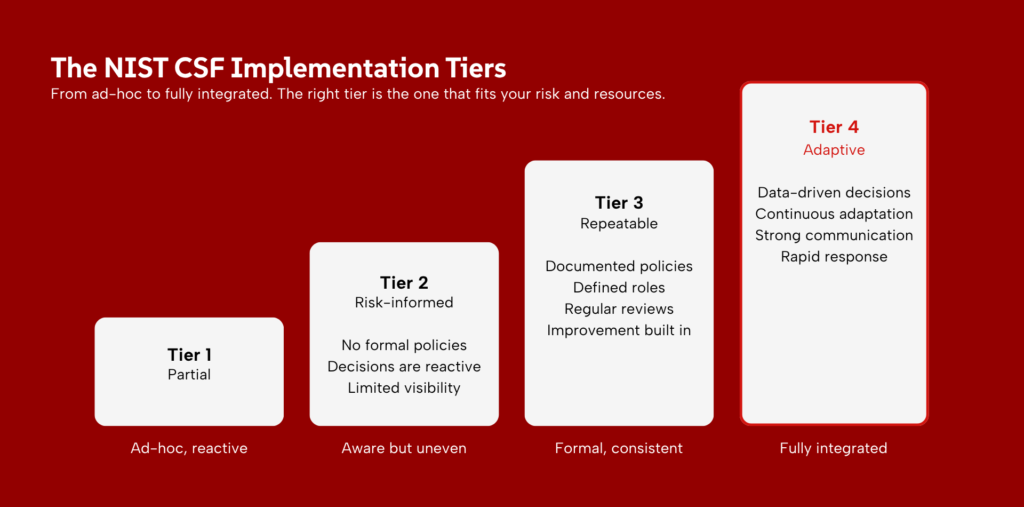
Tier 1: Partial
Cybersecurity is handled in an ad-hoc way, with no formal policies or risk processes. Decisions are reactive, made when something goes wrong, and security awareness is low across the organisation. There is little visibility into what assets exist or how they are protected.
Tier 2: Risk-Informed
Risk management practices exist, but they are not standardised across the organisation. Leadership is aware of cybersecurity risk and approves some priorities, but execution is uneven. Policies are written but not consistently followed, and information is not shared well across teams.
Tier 3: Repeatable
Cybersecurity practices are formal, documented, and applied consistently across the organisation. Risk management is part of how the business runs, with clear policies, regular updates, and defined roles. There are processes for responding to threats, and they are reviewed and improved over time.
Tier 4: Adaptive
Cybersecurity is fully integrated into how the organisation operates. The security programme adapts continuously based on lessons learned, threat intelligence, and changes in the business. Decisions are data-driven, communication is strong at every level, and the organisation can respond to new risks quickly and confidently.
How NIST CSF Aligns With Other Standards
The NIST CSF is not built to replace other standards. It sits above them as the organising layer, while other standards fill in the detailed controls, audit rules, or legal requirements.
NIST even publishes official mappings, called “informative references,” that connect CSF outcomes to specific controls in other standards. That means you can adopt CSF without throwing away what you already use.
ISO 27001
ISO 27001 is the international standard for information security management. CSF gives you the structure; ISO 27001 gives you the auditable certification you can show to clients and regulators. Most organisations use them together, design the programme with CSF, then prove it with ISO 27001.
CIS Controls
CIS Controls is a prioritised list of specific, practical safeguards from the Center for Internet Security. CSF tells you what outcomes to aim for; CIS Controls tells you which actions to take. Teams often use CSF for strategy and CIS as the daily playbook for engineers.
NIST SP 800-53
NIST SP 800-53 is a catalogue of more than 1,000 detailed security controls used across US federal systems. CSF gives the high-level structure, and SP 800-53 gives the controls that fit underneath.
NIST publishes a direct mapping between every CSF outcome and the SP 800-53 controls that support it. Federal agencies usually need both; private organisations often pick CSF first and use SP 800-53 controls only where they make sense.
Regulatory Requirements
Most major regulations map to CSF, including HIPAA, PCI DSS, GDPR, and many regional data protection laws. By adopting CSF, you get one structure that meets the security requirements of several regulations at once, instead of running a separate programme for each one.
Building a Cybersecurity Program with NIST CSF
The framework is most useful when you treat it as a process, not a document. The seven steps below take an organisation from a blank page to a working, measurable cybersecurity programme.
1. Define your security goals
Start with what your business is trying to protect and why. Identify the data, systems, and operations that matter most, and the level of risk the leadership is willing to accept. These goals shape every decision that follows, so they need to come from the top, not from the IT team alone.
2. Understand your current security posture
Map what you already have in place. Document existing policies, controls, tools, and processes, then compare them against the CSF Core to see which outcomes you already meet and which you do not. This is your current profile, the honest picture of where you stand today.
3. Assess cybersecurity risks
Once you know what you have, work out what could go wrong. Identify the threats most relevant to your business, the weaknesses an attacker could exploit, and the impact each one would have. The output is a prioritised view of risk, sorted by likelihood and severity.
4. Create a plan for improvement
Decide where you want to be and how you will get there. Build a target profile that describes the cybersecurity outcomes you need, then compare it to your current profile. The gap between the two becomes your improvement plan, broken into projects, owners, and timelines.
5. Implement security controls
This is where the plan turns into action. Roll out the policies, tools, and processes that close the gaps you identified, in the order that risk demands. The most impactful, foundational controls go first, then the layers that protect and detect, then the program-level practices.
6. Monitor and measure progress
Once controls are in place, watch how they perform. Track the right metrics (incidents detected, response times, training completion, audit findings), and check them against your target profile regularly. Measurement is what turns a one-time project into an ongoing programme.
7. Review and improve continuously
Threats change, business changes, and the framework itself evolves. Set a regular review rhythm (at least annually, plus after any major change) to update your profiles, reassess risk, and adjust the plan. A cybersecurity programme that does not improve stops working.
Challenges When Implementing the Framework
The NIST CSF gives you a clear structure, but adopting it is rarely simple. Most organisations hit the same set of challenges along the way. Knowing what to expect makes them easier to plan for.
1. Knowing what needs protection
You cannot protect what you have not mapped, but most organisations cannot list every system, device, account, and data store in a week. Without a clear inventory, every other step rests on guesswork. This is why the framework places so much weight on the Identify function.
2. Limited time, budget, and resources
Cybersecurity competes with every other priority for funding and attention. The fix is not to do everything at once. Start with the highest-impact outcomes (Govern, Identify, and Protect) and build outward as resources allow.
3. Turning the framework into action
CSF tells you what outcomes to aim for, not how to reach them. That flexibility is a strength, but it can leave teams unsure where to begin. The fix is to map CSF outcomes to specific controls from CIS, SP 800-53, or your own playbook.
4. Managing third-party risks
Your security is only as strong as the partners and vendors you rely on. CSF 2.0 moved supply-chain risk into Govern, but assessing dozens of third parties is still a real lift. It usually means building a vendor review process, not running a one-off questionnaire.
5. Getting leadership support
Without backing from the top, CSF adoption stalls. Security needs budget, cross-team cooperation, and visibility at board level, and none of that happens by accident. The new Govern function makes leadership involvement structural, but earning that engagement still takes a clear, business-grounded case.
6. Keeping up with changing threats
The framework updates every few years; the threat landscape changes every day. Controls that worked last year may not hold today, and a static implementation drifts out of alignment with the risks it was meant to address. Treat CSF as a living programme, with regular reviews and updates.
7. Measuring success
Proving the value of cybersecurity is hard, because the best outcome is that nothing happens. CSF helps by giving you measurable subcategories and tier definitions, but choosing the right metrics still takes judgement. Without good metrics, the programme can look invisible until something goes wrong.
NIST CSF Success Stories
The framework’s value shows best in the organisations that have used it. NIST publishes an archive of case studies showing how different organisations have adopted the CSF and what they gained.
The three below show the framework’s reach: a global energy company, a national government, and a country’s central cyber authority.
1. Saudi Aramco
Saudi Aramco, one of the world’s largest energy companies, adopted the NIST CSF to standardise cybersecurity across its enterprise. The Framework gave the company a single language for cybersecurity conversations between corporate leadership, the CISO’s office, and both IT and operational technology (OT) teams.
It also provided a way to measure cybersecurity maturity consistently, set targets at the corporate level, and align with national regulators such as Saudi Arabia’s National Cybersecurity Authority.
2. Government of Bermuda
The Government of Bermuda used the CSF to bring consistency to cybersecurity across its ministries and departments. A self-assessment against the framework helped identify gaps, control weaknesses, and high-risk areas, and the results were reported to the Cabinet on a regular basis using the framework as a dashboard.
The outcome was a standardised, government-wide approach to risk that aligned security activities with business needs and gave the public sector a shared structure for managing cyber threats.
3. Israel National Cyber Directorate (NCD)
Israel’s National Cyber Directorate adopted the NIST CSF as part of its broader strategy for protecting critical national infrastructure and improving collaboration between public and private organisations.
The framework gave the NCD and the industries it works with a shared vocabulary for cybersecurity risk, simplifying communication between executives and cyber defence managers across sectors. It also supported a more structured approach to assessing where organisations stood and what they needed to do next.
Making NIST CSF Work for Your Organisation
The hardest question after reading a framework guide is always the same: what do we actually do now?
The framework gives you the structure, but the work of running it, mapping assets, monitoring systems, testing controls, takes time and people most teams do not have spare.
A managed partner closes that gap.
Zentara’s Managed SOC covers continuous monitoring and response. Our VAPT engagements test the controls that matter most. Together they turn the framework’s six functions into a programme that actually runs.
If you want to know where you stand, request a NIST CSF gap assessment and we will map your current and target profiles.