

A commercial leader’s perspective on cybersecurity as a growth engine
There is a noticeable shift in boardrooms across industries: cybersecurity is no longer discussed only when something goes wrong. Commercial leaders are starting to recognise a simple reality. Customers do not just buy products. They buy confidence, continuity, and credibility.
As digital transformation accelerates, organisations are more interconnected and more exposed. This means the strength of your cybersecurity posture can now make or break sales opportunities. The most forward-thinking companies are treating security as a value driver. The question has evolved from “How do we defend ourselves?” to “How do we turn trust into a commercial advantage?”
This shift matters now because the competition is not standing still. Those who can prove security maturity are increasingly the ones who win.
The New Commercial Reality
The business landscape has fundamentally changed:
- Buyers are more educated and risk-aware.
- Procurement teams demand security validation before contracts are signed.
- Regulators and enterprise customers require proof of compliance.
- Cyber incidents are widely publicised, impacting brand and revenue.
In this climate, even a convincing sales pitch can falter if security concerns surface. Deals stall. Procurement gates tighten. Vendors without demonstrable cyber readiness lose out to those who can offer tangible assurance.
Recent events highlight how threat actors no longer just go after network perimeters, they exploit trust, human error, and integrations. For example, a 2025 incident involving a major CRM platform, Salesforce, revealed that attackers used social engineering and malicious third-party apps to compromise customer data, bypassing traditional perimeter defences.
Research from Digicert shows that modern threats increasingly target identity, cloud environments, and applications, rather than legacy network boundaries.
In this new environment, cyber maturity is no longer optional, it is a threshold requirement for commercial participation.
What Zentara Sees in the Field
Supporting organisations operating in cloud-native, hybrid, and multi-cloud environments, Zentara sees a clear commercial pattern emerging:
Security sells.
When security is embedded into product design and operations early, companies can confidently enter markets with more demanding buyers. They move from proposal to contract faster because many of the hardest questions have already been answered.
Proof of security unlocks partnerships.
Large enterprises and regulated sectors expect suppliers to meet or exceed their own security standards. Vendors who can demonstrate operational resilience, compliance mapping, and strong data governance frequently become preferred partners.
Resilience reduces revenue risk.
Unplanned downtime or breach response is not just a technical problem. It disrupts service delivery and directly impacts revenue. Organisations that can rapidly detect and respond maintain customer confidence and avoid costly churn. As IBM observed, using automation and data resilience strategies can meaningfully cut the cost of a breach compared to reactive, perimeter-focused security.
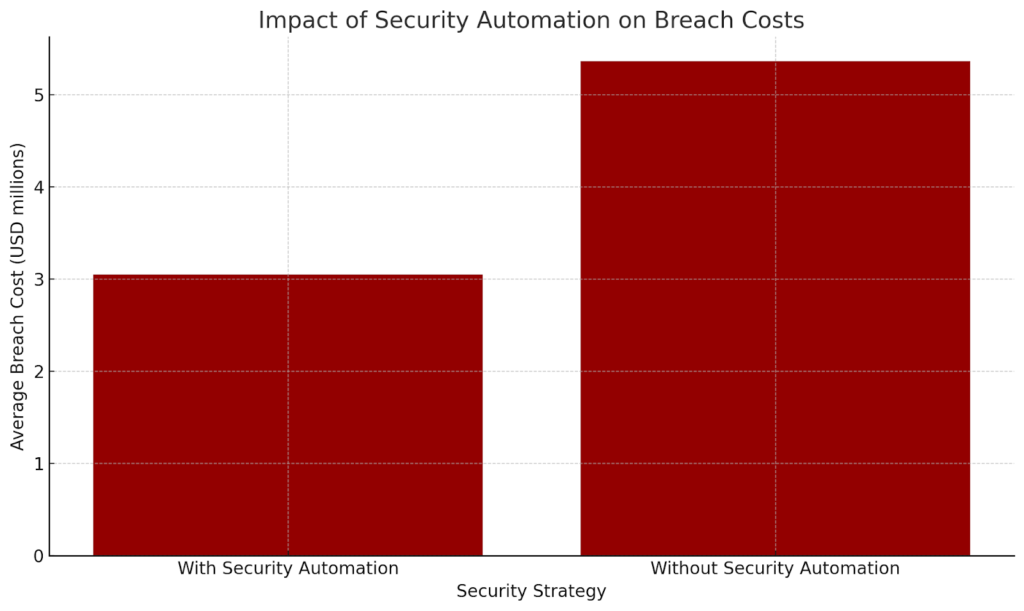
IBM Cost of a Data Breach Report 2023
Security strengthens brand positioning.
Companies that treat cybersecurity as part of their narrative differentiate themselves from competitors who only discuss features and pricing. Trust becomes a strategic brand asset. This is especially true as enterprises increasingly view vendors’ security posture as part of their own risk.
Quite simply, the companies who prioritise cyber today are winning deals tomorrow. Those who do not will increasingly struggle to compete.
A Commercial Framework for Turning Security into Advantage
To shift cybersecurity from a cost to a growth driver, leaders can adopt this practical framework:
1. Build Trust Into the Product Story
Do not wait for procurement questionnaires to reveal gaps. Make security part of your value proposition from the first conversation.
Translate technical capabilities into commercial outcomes:
- Better protection of customer IP and data.
- Faster onboarding and fewer compliance delays.
- Business continuity and guaranteed service performance.
- Reduced risk in the customer’s supply chain.
Trust should be visible, not assumed.
2. Align Security Metrics with Business Outcomes
Boards and customers care about:
- Reduced downtime.
- Faster delivery of new features.
- Proven regulatory readiness.
- Demonstrated risk reduction.
Frame cybersecurity investments in these terms. Show how they lead to revenue acceleration, international expansion, or stronger retention.
3. Treat Security as a Competitive Differentiator
Security certifications, resilient cloud architecture, and transparent incident-response processes are not administrative badges. They are commercial accelerators.
Sales and BD teams should be equipped to use security strengths as selling points:
- Case studies showing resilience in action.
- Evidence of secure development practices.
- Third-party validation and compliance documentation.
This is where security and business development must collaborate. The companies who connect these dots will consistently move faster.
Winning the Market Through Resilience
Cybersecurity is no longer just a defensive function. It is a commercial strategy.
Organisations that embed security into their product portfolio and go-to-market approach achieve:
- Faster and smoother deal cycles.
- Greater eligibility for high-value enterprise and regulated markets.
- Higher customer trust and lifetime value.
- Increased brand resilience and differentiation.
In a future where risk perception influences buying decisions, trust is currency. The winners will be those who turn cybersecurity into a proactive enabler of growth, not a reactive cost of doing business.
If your organisation is ready to transform security into a commercial edge, Zentara can help. Start the conversation here