
Artificial intelligence is already embedded in how enterprise projects are planned, tracked, and reported. From automated scheduling to predictive risk analysis, AI tools are changing day-to-day project management faster than most organizations expected.
For Project Managers, the real question is no longer whether AI will change the role. It’s where AI genuinely helps, and where human judgment remains irreplaceable.
Understanding that distinction is the difference between using AI as leverage and being overwhelmed by it.
Why AI Adoption in Project Management Feels Unsettling
Project management has always been a discipline built on coordination, judgment, and trust. AI challenges all three.
Many PMs worry about:
- Losing ownership of planning and prioritization
- Being reduced to “tool operators” instead of decision-makers
- Automation masking real risks rather than revealing them
These concerns are valid. But they stem less from AI itself and more from unclear boundaries around what should be automated, and what should not.
What AI Should Automate in Enterprise Projects
Used correctly, AI excels at reducing friction in areas that drain time but add little strategic value.
1. Planning and scheduling optimization
AI tools can analyze dependencies, historical timelines, and resource availability far faster than manual methods. This helps generate realistic schedules and continuously adjust them as conditions change.
2. Task and status automation
Routine updates, progress tracking, and report generation are ideal candidates for automation. AI can consolidate data from multiple tools and surface meaningful summaries without constant manual input.
3. Risk pattern detection
AI can identify early warning signals: slipping milestones, overloaded teams, recurring blockers—that humans often notice too late. This works best as decision support, not autonomous decision-making.
4. Resource forecasting
By analyzing historical utilization and delivery patterns, AI can support more accurate capacity planning and highlight upcoming constraints.
In all these cases, AI functions as an accelerator, not a replacement.
What AI Should Not Automate
Where enterprises go wrong is handing AI responsibilities that require context, accountability, and judgment.
1. Stakeholder alignment and communication
AI can draft updates. It cannot navigate politics, manage expectations, or build trust. These remain core PM responsibilities.
2. Strategic trade-off decisions
AI can model scenarios, but deciding whether to cut scope, extend timelines, or absorb risk is a leadership decision—not an algorithmic one.
3. Team leadership and morale
Delivery succeeds or fails on people. Motivation, conflict resolution, and cross-functional collaboration cannot be automated without cost.
4. Accountability for outcomes
AI can inform decisions, but it cannot own consequences. Enterprises still need humans accountable for delivery.
Automation without boundaries creates false confidence and hidden risk.
Real-World Integration: What Works in Practice
Teams seeing real value from AI in project management follow a few consistent principles:
- AI is introduced incrementally, not all at once
- Outputs are reviewed, challenged, and refined by PMs
- Automation supports workflows instead of dictating them
- Governance and controls are defined early, especially in regulated environments
This approach avoids the common trap of tool sprawl, or the unchecked accumulation of disconnected project, automation, and AI tools across teams. In many enterprises, new tools are added to solve local problems without retiring old ones, leading to duplicated data, inconsistent reporting, fragmented workflows, and reduced visibility for leadership.
When AI tools are layered on top of an already fragmented stack, the problem worsens. Decisions become harder to trace, risks are surfaced inconsistently, and accountability is diluted. By defining clear boundaries for automation and keeping humans responsible for judgment and outcomes, organizations preserve oversight where it matters most, while still benefiting from AI-driven efficiency.
How AI Is Changing the PM Role (Without Replacing It)
AI shifts the PM role up, not out.
As routine work is automated, PMs increasingly focus on:
- Decision quality instead of data collection
- Risk interpretation instead of risk reporting
- Strategic communication instead of status administration
In practice, this makes experienced PMs more valuable, not less.
Preparing Your Project Management Career For 2026
Staying relevant in an AI-augmented environment requires deliberate adaptation.
Enterprise PMs should focus on:
- Understanding how AI tools reach conclusions, not just their outputs
- Strengthening business and risk literacy
- Developing judgment in ambiguous, high-stakes scenarios
- Leading hybrid teams where automation and humans work together
AI fluency becomes a baseline skill. Human judgment becomes the differentiator.
Join the Webinar: AI in Project Management
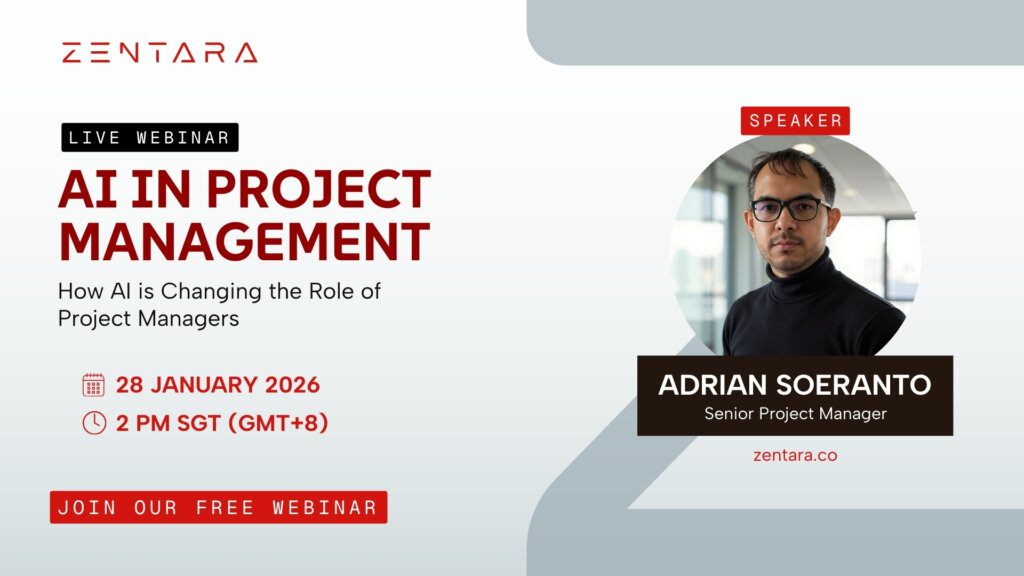
These topics, and real-world examples of how teams are applying them, will be explored in depth during Zentara’s upcoming live webinar: AI in Project Management – How AI is Changing the Role of Project Managers.
Led by Adrian Soeranto, Senior Project Manager at Zentara, the session cuts through hype to focus on what actually works in enterprise environments, and how PMs can stay indispensable as AI adoption accelerates.