
Indonesia’s digital economy is expanding faster than its cybersecurity workforce. As organisations accelerate cloud adoption, digital banking, and critical infrastructure modernisation, the demand for skilled cybersecurity professionals continues to outpace supply. This gap is no longer just a hiring challenge; it is a structural constraint on national cyber resilience. To address this, strategic cybersecurity capacity building has become a capacity requirement rather than a productivity enhancement.
At the same time, artificial intelligence and automation are reshaping how security operations are designed, executed, and scaled. The question is no longer whether AI will enter security operations, but how effectively it can be operationalised to close capability gaps without introducing new risks.
Indonesia’s Cybersecurity Talent Shortage Is Structural
The cybersecurity workforce gap in Indonesia is acute due to the scale of digital transformation underway across both public and private sectors. According to the ISC2 Cybersecurity Workforce Study 2024, the global gap exceeds 4 million professionals, with persistent shortages in threat detection, incident response, and cloud security roles.
In Indonesia, this gap is amplified by rapid digitisation across banking, telecommunications, energy, and government services. To maintain security, cybersecurity capacity building must pivot toward models where demand can scale exponentially through technology, rather than relying on human capacity that only scales linearly.
Why Traditional Scaling Models No Longer Work
Historically, cybersecurity capacity has scaled through headcount expansion and outsourced managed services. That model is increasingly insufficient for three reasons:
1. Threat velocity exceeds human response time
Modern attacks, particularly automated phishing campaigns, ransomware deployment chains, and credential-based intrusions, operate at machine speed. Human-only response models cannot consistently match this velocity.
2. Alert volume overwhelms security teams
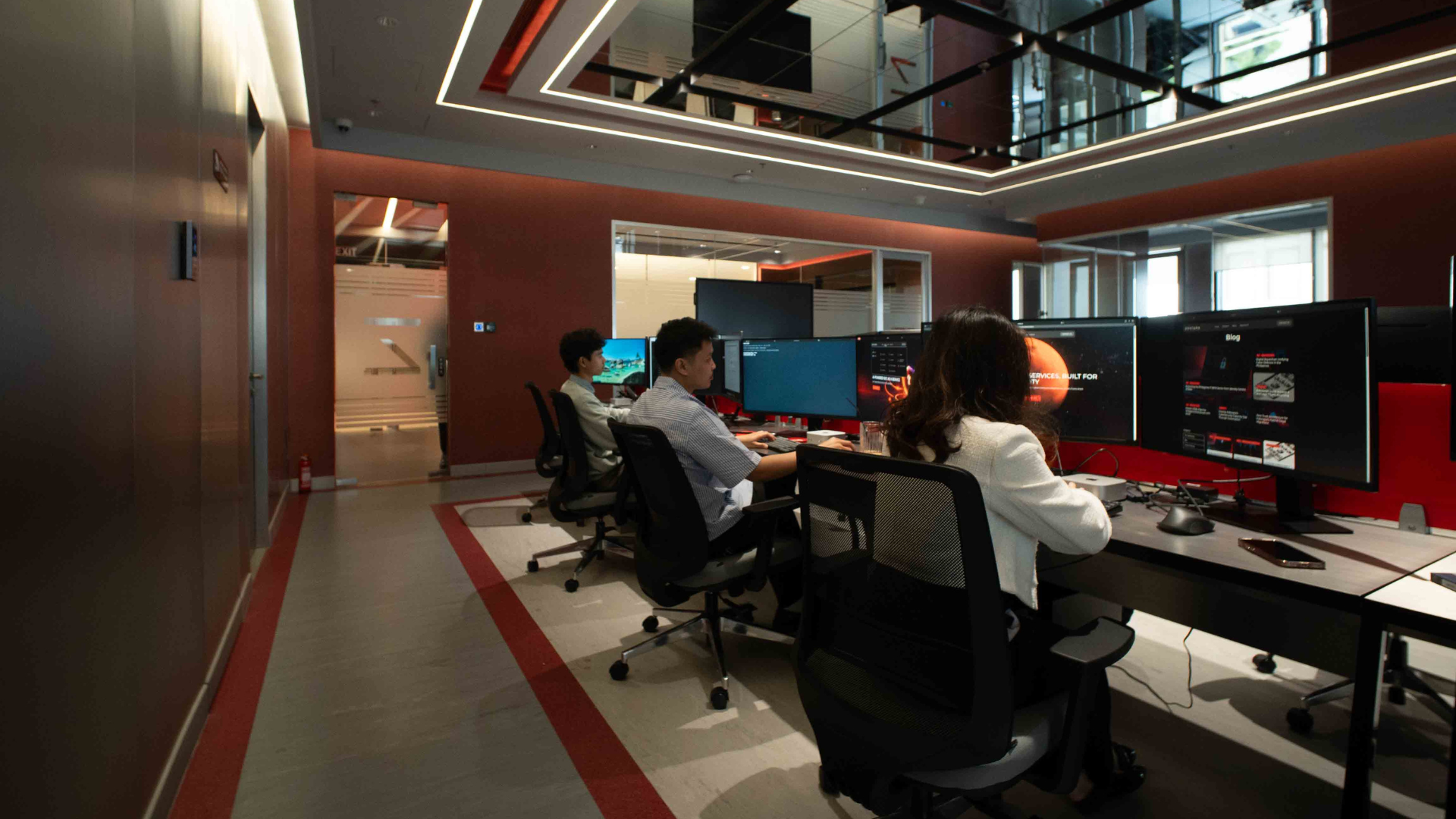
Security Operations Centers (SOCs) generate thousands of alerts daily across daily without threat detection automation, triage becomes a bottleneck that increases attacker dwell time.
3. Skill specialization fragmentation
Cybersecurity now spans cloud security, application security, OT security, identity governance, and AI-driven threat analysis. No single team can fully cover all domains at scale.
AI as a Force Multiplier in Cybersecurity
Artificial intelligence does not replace professionals; it extends their operational capacity. When properly implemented, AI enables security teams to detect anomalies across large-scale telemetry in real time and automate low-level triage. This transition is a core pillar of cybersecurity capacity building, reflecting a shift toward AI-assisted security operations.
Closing the Gap Between Threat Scale and Human Capacity
In Indonesia’s context, AI-driven automation is not a productivity enhancement. It is a capacity requirement.
Three areas where AI has immediate operational impact:
- Security Operations Center (SOC) automation: AI can filter, classify, and prioritize alerts, allowing analysts to focus on high-confidence threats rather than noise reduction.
- Threat detection and anomaly identification: Machine learning models can detect deviations from baseline behavior across network, identity, and cloud activity faster than rule-based systems.
- Incident response acceleration: Automation can execute predefined response playbooks, such as isolating endpoints or revoking credentials, reducing containment time during active breaches.
The New Security Model: Human + Machine Collaboration
The future of cybersecurity capacity building is not human versus machine, but human with a machine.
- AI handles scale, speed, and pattern recognition
- Human analysts handle judgment, escalation, and contextual decision-making
- Automation bridges execution gaps between detection and response
This hybrid model directly addresses Indonesia’s workforce constraint by amplifying existing talent rather than waiting for workforce expansion to catch up with demand.
Scaling Defence Through Intelligence, Not Headcount
Indonesia’s cybersecurity challenge is a scaling problem in an environment where threats grow faster than human capacity. Artificial intelligence provides a pathway to close that gap, provided it is implemented with strong governance and integrated into existing workflows.
Focusing on long-term cybersecurity capacity building allows organisations to maintain continuity even under operational pressure. Zentara works with enterprises and critical infrastructure operators to design AI-enabled cybersecurity architectures that enhance detection and strengthen operational resilience.
Speak with our cybersecurity experts to identify how cybersecurity capacity building and automation can reduce operational gaps in your current SOC and incident response model.