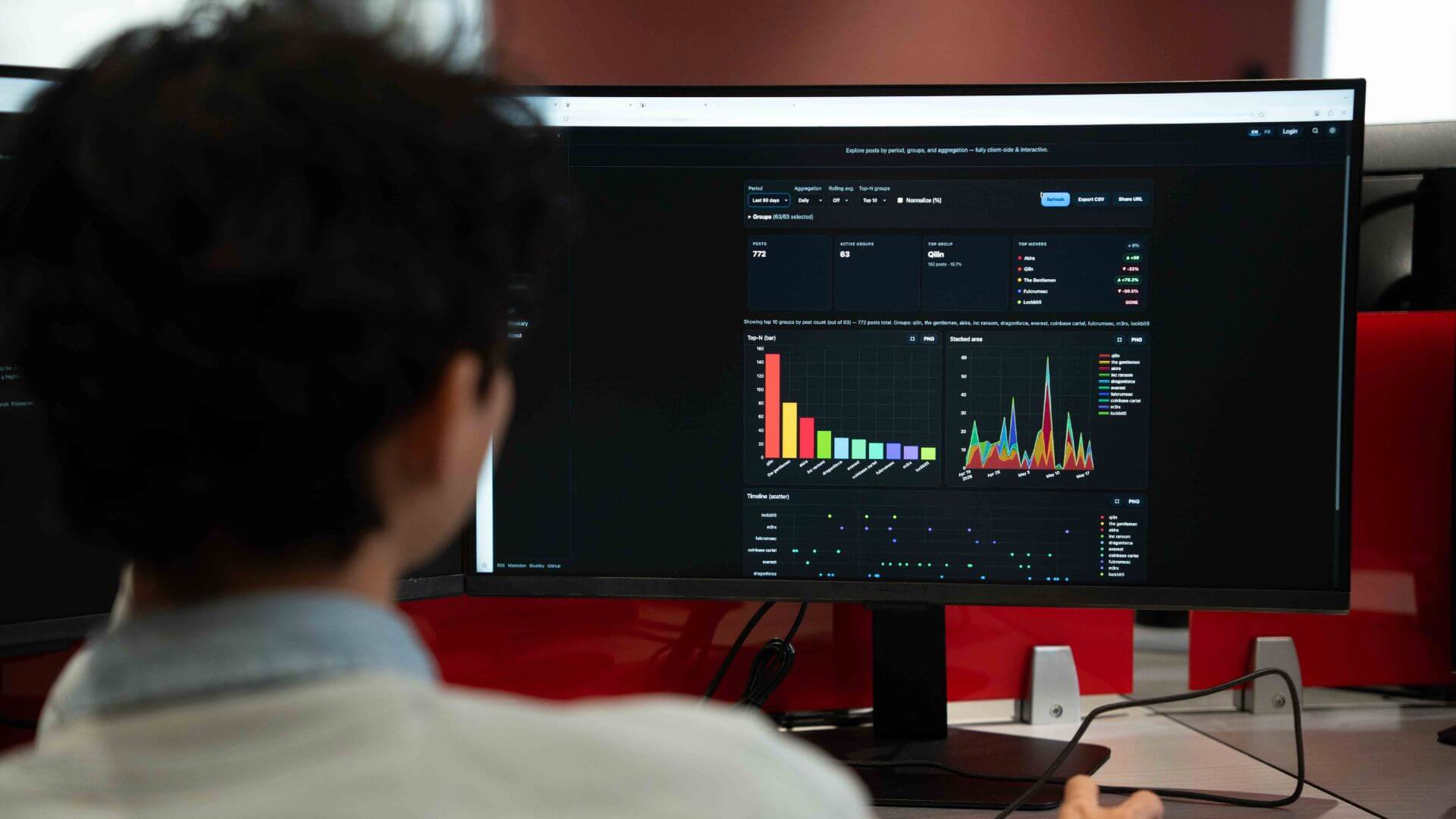

Every organisation runs on digital systems now, and each of those systems is something an attacker would like to reach. So the useful question is not whether an attack will come. It is whether your defences will hold when it does.
That question has a price tag. IBM’s Cost of a Data Breach Report 2025 put the global average cost of a breach at $4.44 million, and in the United States it climbed to a record $10.22 million, pushed up by regulatory fines and slow detection.
This guide walks through the questions people actually ask. What cybersecurity is, how it works, why it matters, and where to begin. Throughout, we treat security as something you design and maintain, an architecture, not a product you buy once and leave alone.
What Is Cybersecurity?
Cybersecurity is the practice of protecting systems, networks, devices, and data from digital attacks, unauthorised access, and disruption. It combines technology, processes, and people to keep information confidential, accurate, and available to the right users.
Security teams measure that work against three goals known as the CIA triad: confidentiality, integrity, and availability. Confidentiality keeps data private, integrity keeps it accurate and unaltered, and availability keeps it accessible to the people who are meant to have it.
The scope of this protection keeps widening. IoT Analytics estimates there are now between 21 and 24 billion connected devices worldwide, and each one adds to what a security programme has to account for.
This is why we treat security as an architectural property of your systems, designed in layers and maintained over time, closer to the foundation of a building than a lock added to the door afterward.
How Does Cybersecurity Work?
Cybersecurity works by combining three elements that depend on each other: people, processes, and technology.
- Technology provides the tools, such as firewalls, encryption, and monitoring systems.
- Processes set the rules for how those tools are used and how the organisation responds when something goes wrong.
- People apply both, and remain the factor attackers target most often.
No single tool is enough on its own, so effective security is built in layers. This approach, known as defence in depth, places controls across identity, access, data, applications, infrastructure, and monitoring.
If one layer fails, the next one still stands, the same way a building has locks, alarms, and cameras rather than relying on a single door. Each layer is tested and reviewed on a regular rhythm, because a control that worked last year may not hold against this year’s methods.
Part of that testing comes from two specialised groups that approach security from opposite directions:
Red Team
A red team plays the role of the attacker. These are security professionals who simulate real attacks against an organisation’s systems, using the same techniques an actual adversary would, to find weaknesses before someone with bad intent does.
Their work includes penetration testing, social engineering attempts, and probing for gaps in defences, and the findings show an organisation exactly where it is exposed.
Blue Team
A blue team plays the role of the defender. They monitor systems, detect suspicious activity, respond to incidents, and harden the gaps a red team exposes.
Where the red team works to break in, the blue team works to keep watch and shut threats down, and when the two operate together in a continuous loop, sometimes called purple teaming, testing stops being a one-off exercise and becomes an ongoing discipline.
Roles in a Cybersecurity Team
Red and blue teams represent two specialised functions, but a complete security operation depends on a broader team of professionals, each responsible for a distinct part of the organisation’s defence:
- Security Operations Center (SOC) analysts monitor systems around the clock and are usually the first to spot a threat.
- Threat hunter searches proactively for attackers who have slipped past automated defences.
- Incident responder takes over once a breach is confirmed, containing the damage and restoring operations.
- Security architect designs how all the controls fit together across the organisation.
- Chief Information Security Officer (CISO) owns the security strategy and answers for it at the board level.
The catch is that these people are hard to find. The 2025 ISC2 Cybersecurity Workforce Study put the global talent gap at 4.8 million unfilled positions, with Asia-Pacific carrying the largest regional shortfall at 3.4 million.
For many organisations, building and keeping a full in-house team is not realistic, which is why a growing number rely on managed security services to cover the roles they cannot staff themselves.
Why Cybersecurity Matters
The damage from a security failure rarely stops at the financial line. A single incident can expose private data, halt operations, and erode trust that took years to build. Strong cybersecurity protects an organisation in six concrete ways.
1. Protecting sensitive and personal data
Organisations hold data people trust them to keep private: customer records, payment details, health data, intellectual property. Cybersecurity keeps it confidential and intact. In most regions, protecting it is also the law.
2. Preventing malware and ransomware attacks
Layered defences stop malicious software before it spreads, encrypts files, or locks systems for ransom. Prevention costs a fraction of recovery, and paying a ransom rarely guarantees the data comes back.
3. Safeguarding critical infrastructure
Power grids, hospitals, banks, and telecom networks keep society running. When attackers hit this kind of infrastructure, the risk is no longer just financial. It becomes a matter of public safety.
4. Meeting regulatory and compliance obligations
More industries now require organisations to meet security standards and report breaches. These fall into two groups:
- Laws you must follow, such as Indonesia’s Personal Data Protection Law or Singapore’s Cyber Security Agency requirements.
- Voluntary frameworks that prove good practice, such as the NIST Cybersecurity Framework, ISO/IEC 27001, and the CIS Controls.
Falling short can mean fines and lost contracts. Increasingly, larger partners also check your security before agreeing to work with you.
Types of Cybersecurity
Cybersecurity is not one discipline but several, each protecting a different layer of an organisation’s systems. These are the seven main types:
1. Network Security
Protects the internal network from unauthorised access and intercepted traffic. Tools like firewalls, intrusion detection, and network segmentation keep attackers from moving freely once they are inside.
2. Cloud Security
Secures data, applications, and infrastructure hosted in the cloud. Because responsibility is shared between the provider and the customer, knowing which side owns which control is half the work.
3. Endpoint Security
Defends the devices people actually use: laptops, phones, servers, and workstations. Each device is a potential entry point, so endpoint protection watches for malware, suspicious behaviour, and unauthorised access.
4. Application Security
Builds protection into software so attackers cannot exploit flaws in the code. The strongest approach catches vulnerabilities during development, not after the application is already live.
5. Identity Security
Controls who can access what, and verifies that users are who they claim to be. Measures like multi-factor authentication and least-privilege access make stolen credentials far harder to misuse.
6. Critical Infrastructure Security
Protects the systems behind essential services such as energy, healthcare, water, and transport. These environments often run older technology that was never designed to be online, which makes securing them both urgent and difficult.
7. AI Security
Protects Artificial Intelligence (AI) systems from misuse and manipulation, and increasingly uses AI to strengthen defence. As organisations adopt AI faster than they secure it, this has become one of the fastest-growing areas of the field.
Common Cyber Threats
Three terms come up often. A threat is a possible danger, a vulnerability is the weakness it targets, and risk is the harm if the two meet. Here are the seven most common threats:
1. Malware and Ransomware
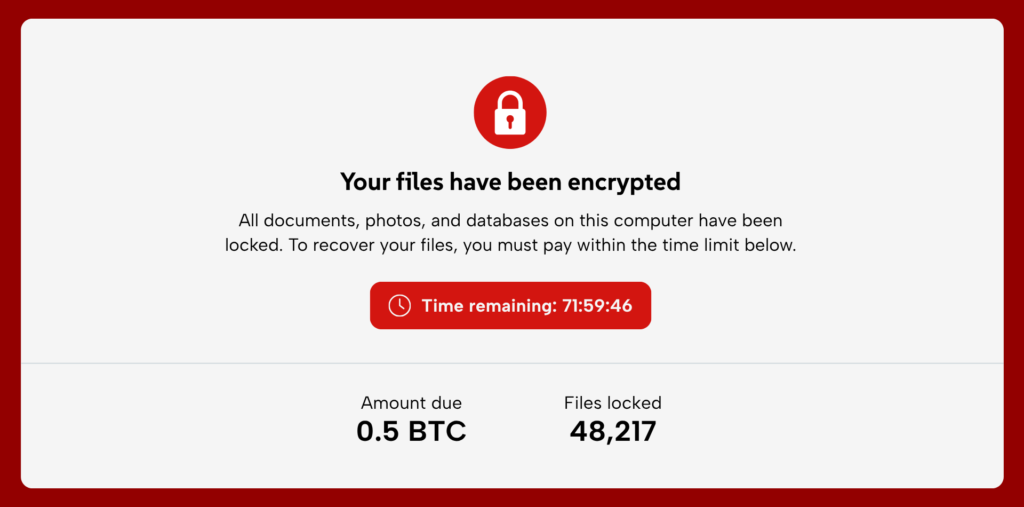
Malware is any software built to harm or break into a system, like spyware or trojans. Ransomware is the worst kind: it locks your files and demands payment to unlock them. The 2021 attack on Colonial Pipeline, one of the largest fuel pipelines in the US, was ransomware that forced a shutdown and caused fuel shortages across the east coast.
2. Phishing and Social Engineering
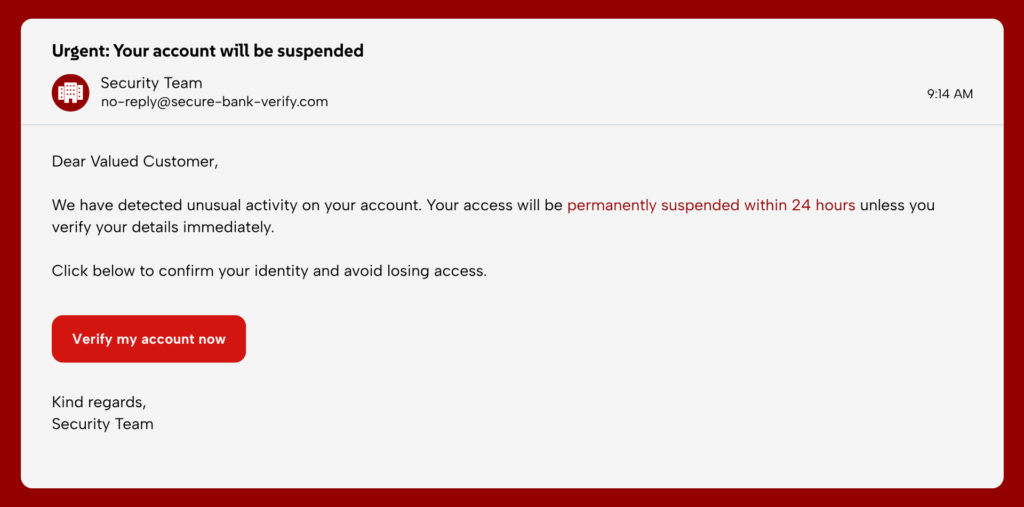
Phishing is a fake message, usually email, that looks real but is built to steal logins or money. It is one form of social engineering, which targets people instead of systems. A typical example is an email that appears to be from your bank or IT team, urgently asking you to “verify your account” through a link that leads to a fake login page.
Also Read: AI-Generated Phishing: Why Social Engineering Is Getting Harder to Detect
3. Insider Threats
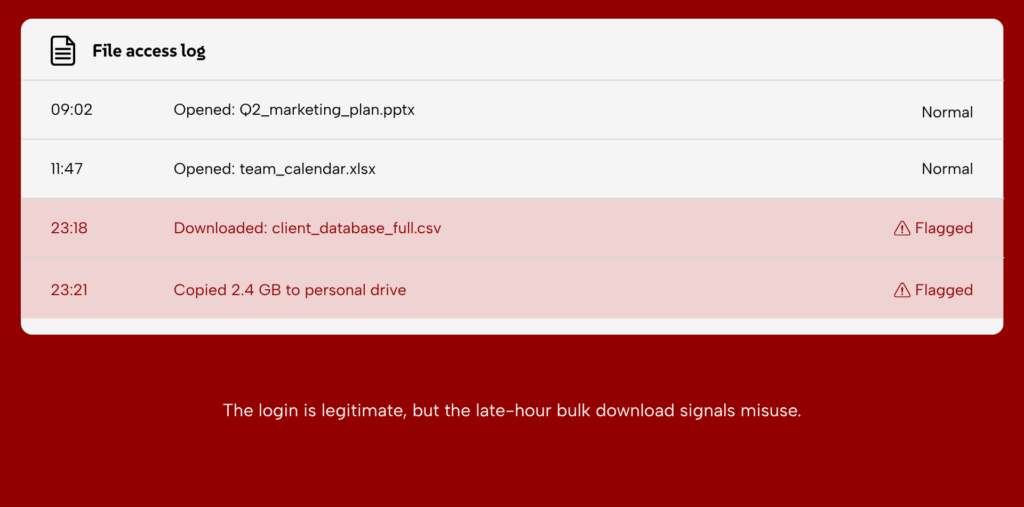
Not every threat comes from outside. An insider threat is an employee, contractor, or partner who misuses their access, on purpose or by mistake. This could be a departing employee copying client data to take to a competitor, or a staff member who accidentally emails a sensitive file to the wrong person.
4. DoS and DDoS Attacks
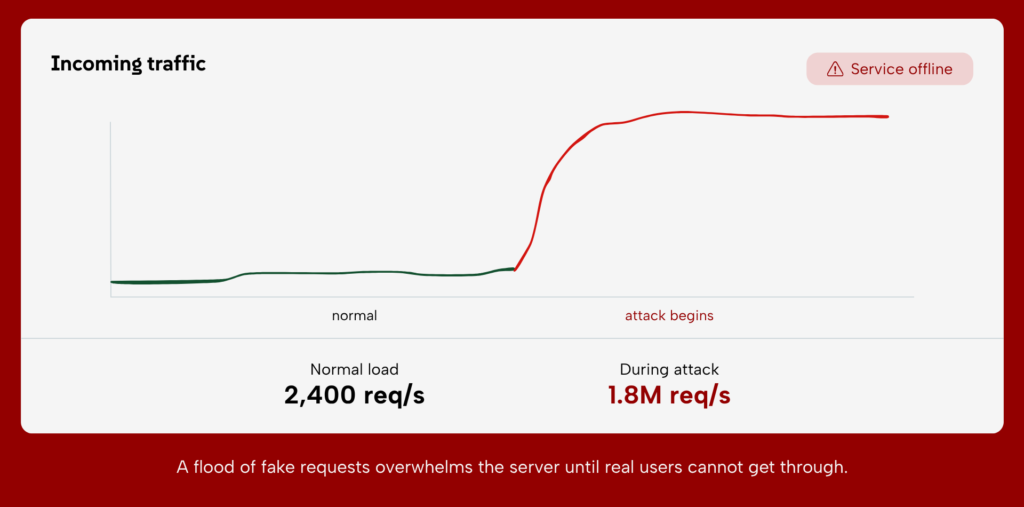
A denial-of-service (DoS) attack floods a system with traffic until it crashes. A distributed version (DDoS) sends that flood from many machines at once, making it harder to block. The aim is not to steal data but to knock systems offline, often paired with a demand for payment.
5. Cryptojacking
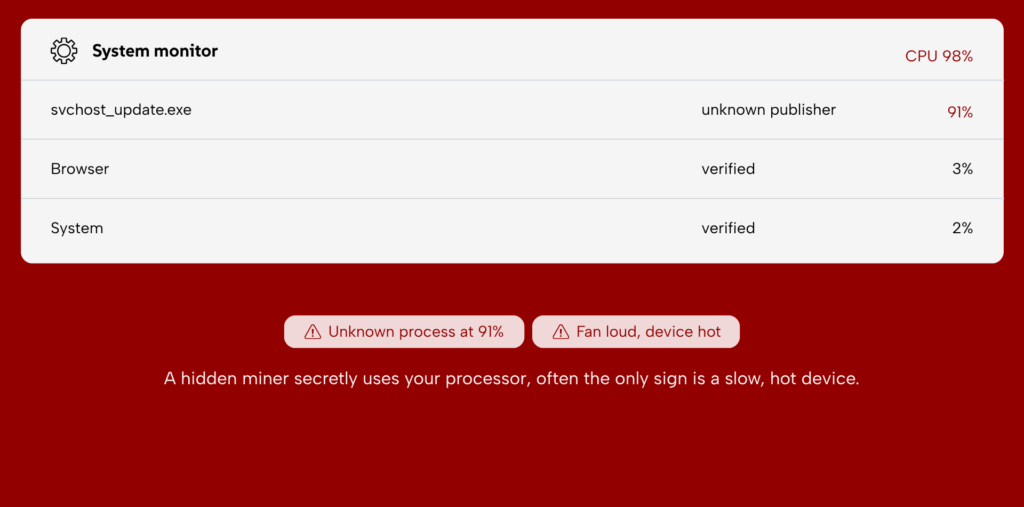
Cryptojacking secretly uses your systems to mine cryptocurrency for the attacker. It rarely steals data, so it often goes unnoticed, but it slows performance and drives up energy and hardware costs. The longer it runs undetected, the more the attacker earns.
6. Advanced Persistent Threats (APTs)
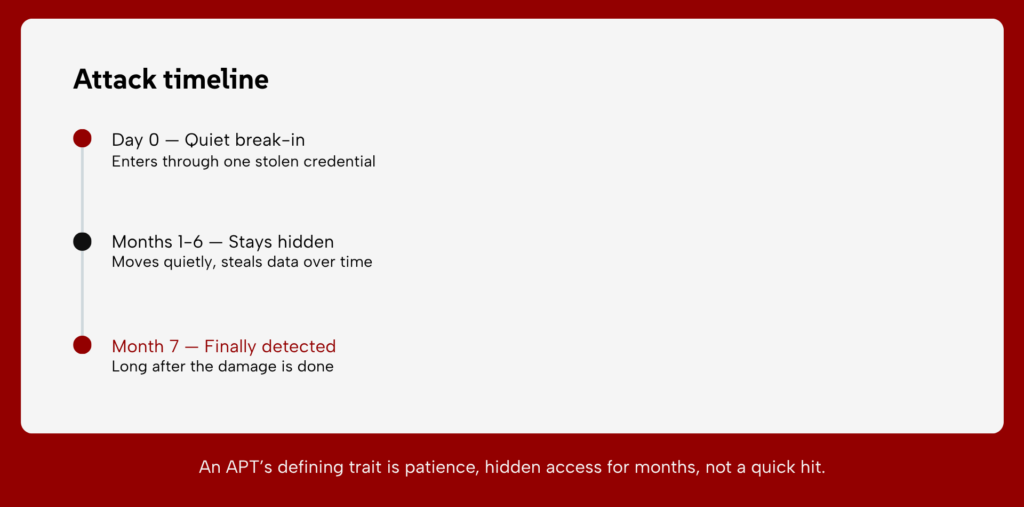
An APT is a long-term attack by a skilled, well-funded group that breaks in and stays hidden for months. Rather than break in and leave, they stay hidden inside a network for months to steal data over time. These attacks usually target government, finance, and critical infrastructure, and catching them takes constant monitoring.
7. AI-Powered and Emerging Threats
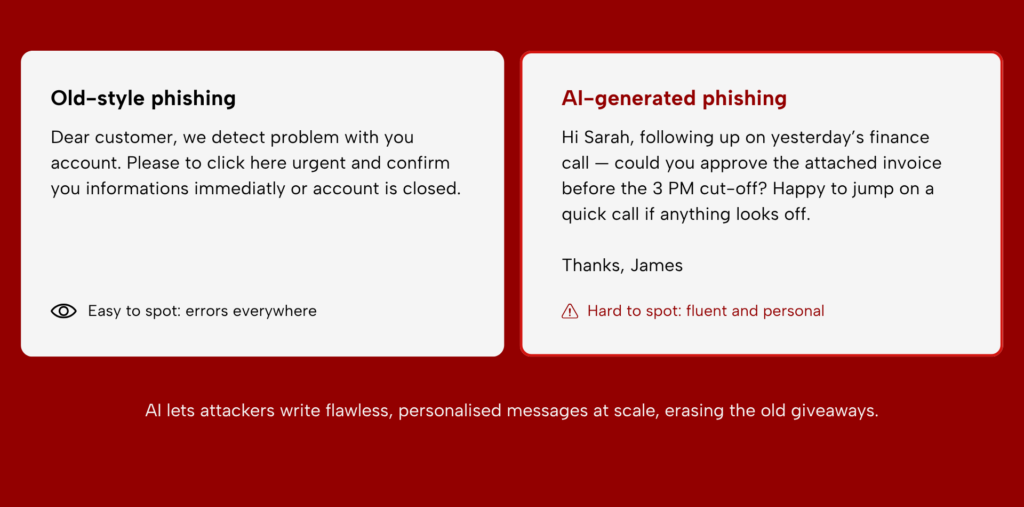
Attackers now use AI to write convincing phishing, create deepfakes, and run attacks at scale. A newer risk is post-quantum: data stolen today, stored, and decrypted once quantum computers are ready. Both point to the same truth: threats keep evolving, and defences must keep pace.
Cybersecurity Myths That Put You at Risk
Some of the most common beliefs about cybersecurity are also the most dangerous, because they create a false sense of safety. Here are five worth correcting.
“Small businesses aren’t targets”
Attackers often prefer small businesses precisely because their defences are weaker. The Hiscox Cyber Readiness Report found that 41% of US small businesses experienced a cyberattack in a single year. Size is no protection; in many cases it is the opposite.
“A strong password is enough”
A strong password helps, but it can still be stolen through phishing, malware, or a data breach. On its own, it is a single lock on a single door. Multi-factor authentication matters far more, because it means a stolen password alone is not enough to get in.
“Antivirus covers everything”
Antivirus catches known malware, but it cannot stop most modern threats on its own. Phishing, insider misuse, and zero-day attacks all slip past it. Real protection comes from layers working together, not one tool doing all the work.
“Security is only IT’s job”
Most breaches begin with a person, not a system, often through a single click on a phishing email. That makes security everyone’s responsibility, from the front desk to the boardroom. Technology can only do so much when the entry point is human.
“Set it up once and you’re done”
Threats change constantly, and defences that worked last year may not hold today. New vulnerabilities appear daily, and unpatched systems are among the easiest ways in. Security is an ongoing practice of monitoring, updating, and reviewing, not a one-time setup.
Best Practices That Reduce Real Risk
Clearing up those myths points to a simple question: what actually works?
No organisation removes risk entirely, but a handful of well-run habits stop the majority of attacks. These five deliver the most protection for the effort:
1. Enforce Multi-Factor Authentication
Multi-factor authentication (MFA) asks for a second proof of identity beyond your password, like a one-time code or a tap on your phone. Even if someone steals your password, they still cannot get in.
Google found that adding a simple SMS code blocked up to 100% of automated bot attacks and 96% of phishing attempts. That is why most major services now offer it.
2. Patch and update regularly
Most attacks exploit known flaws that a patch has already fixed. Keeping software up to date closes those gaps before attackers find them. Automate updates where you can, so nothing slips through.
3. Apply least-privilege access
Give people access only to what their role needs, nothing more. A marketing login, for example, should not be able to open customer payment records. That way, if one account is hacked, the damage stays contained instead of spreading. Review access regularly, and remove it when someone changes roles or leaves.
4. Train people to spot threats
Most breaches start with a person, so awareness is one of your strongest defences. Regular training helps staff catch phishing and scams before they cause harm. The goal is a team that sees security as part of the job.
5. Plan for incidents before they happen
Assume a breach will happen, and decide how to respond in advance. A clear plan, naming who does what, limits damage and speeds recovery. The fastest recoveries come from teams that rehearsed beforehand.
Start Building the Security Your Organisation Needs
The best practices above are not a checklist you finish once. They are habits you keep, because the threats behind them never stop changing.
Cybersecurity is built into your systems and maintained over time. The organisations that get it right do not start by buying tools. They start by understanding what they have, finding where they are exposed, and fixing what matters most first.
That approach is harder than buying a product, but it is the only one that lasts. It also takes real expertise, from round-the-clock monitoring to hands-on testing, and few teams can cover all of it alone.
This is the work Zentara does. We help organisations in high-stakes environments build security that endures, through a Managed SOC that monitors and responds 24/7, and VAPT that tests your defences the way a real attacker would.
If you are figuring out where to start, get in touch with our team to map your first move.