Most enterprises have invested in Data Loss Prevention. Policies are written, tools are deployed, and dashboards show activity. Yet sensitive data still leaks through email, cloud apps, personal devices, and trusted users.
This gap matters more than ever. Data is now everywhere. It lives across SaaS platforms, collaboration tools, endpoints, and third-party environments. IBM notes that DLP is intended to protect sensitive data wherever it resides or moves, but many organisations struggle to apply it consistently in modern, distributed environments. This is where a strong data loss prevention strategy becomes essential.
The problem is not that DLP is obsolete. It is that many DLP strategies were designed for a world that no longer exists.
The current DLP landscape
Traditional DLP focused on known locations and clear boundaries. Files lived on servers. Email was the main exit point. Users worked inside the perimeter.
That model has broken down.
Today’s data is dynamic and often unstructured. It moves continuously between cloud services, messaging platforms, and personal devices. Cyera highlights that many DLP programmes fail at the very first step, data discovery and classification, because organisations no longer have a clear view of where sensitive data actually resides. Strong data classification visibility is now foundational to any effective data loss prevention strategy.
Another challenge is signal overload. Palo Alto Networks points out that overly broad DLP rules generate excessive alerts, leading teams to ignore or disable controls altogether.
Cloud-first environments add further complexity. Cloudflare documents that DLP failures often stem from misconfiguration, inconsistent policy enforcement, and lack of visibility across integrated services.
As a result, many organisations technically have DLP, but practically do not trust it.
What Zentara sees in the field
In practice, Zentara sees three recurring DLP failure patterns.
First, organisations rely on static data classification. Labels are applied once and assumed to remain accurate forever. In reality, data changes. Files are copied, modified, and combined. Material Security notes that outdated or manual classification is one of the fastest ways DLP programmes lose effectiveness.
Second, DLP is treated as a policing tool rather than a risk management control. Policies are written to block behaviour without understanding business context. This leads to workarounds, shadow IT, and frustrated users who see DLP as an obstacle rather than protection.
Third, alerts lack decision value. Security teams receive notifications that data moved, but not whether it mattered. A senior leader once told us they had thousands of DLP. This is where a modern DLP approach must shift from monitoring activity to understanding risk.
The outcome is predictable. Controls are weakened, exceptions multiply, and sensitive data quietly escapes despite the presence of a data loss prevention strategy.
Fixing DLP with a more realistic strategy
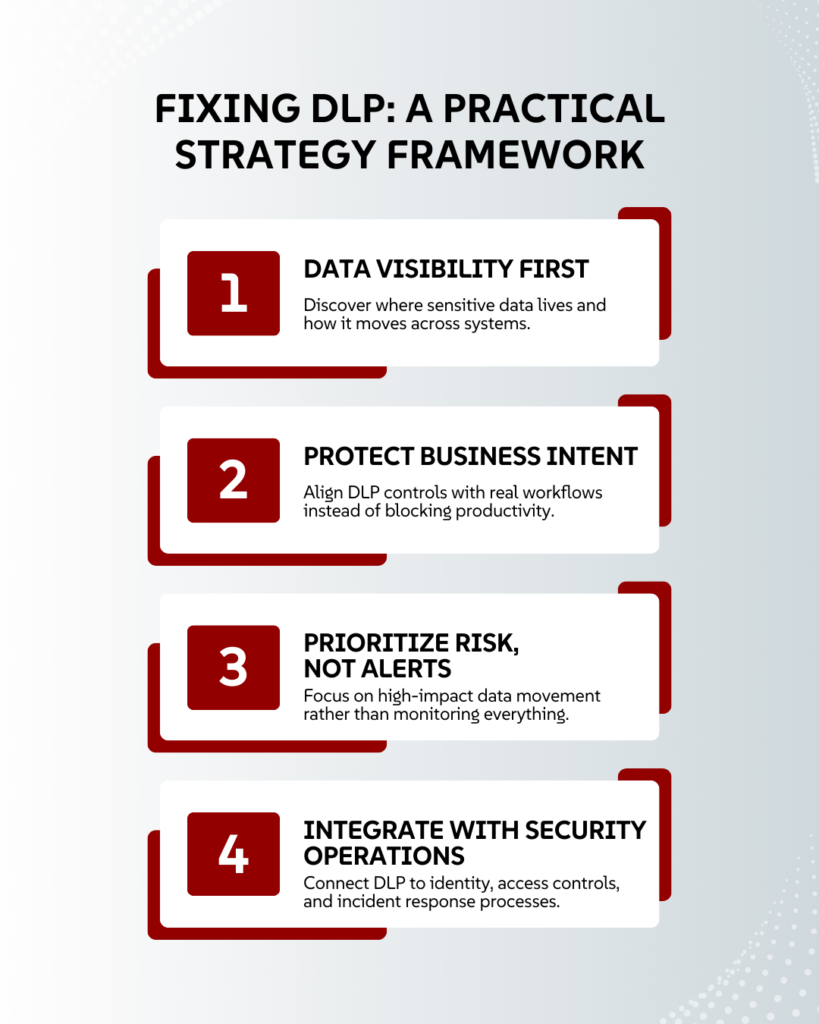
Fixing DLP does not require more rules. It requires a shift in how organisations think about data risk.
1. Start with living data visibility
- Continuously discover where sensitive data actually lives
- Update classification as data moves and changes
- Focus on the most valuable and regulated data first
Without accurate visibility, DLP decisions are guesswork. A mature data loss prevention strategy begins with understanding how data actually flows across the organisation.
2. Align DLP with business intent
- Define why data needs protection, not just how
- Tailor controls to workflows rather than blocking them outright
- Involve business owners in defining acceptable use
Sangfor emphasises that effective DLP strategies balance protection with productivity, rather than prioritising control alone.
3. Prioritise decisions, not alerts
- Reduce noise by focusing on high-risk data movements
- Provide context around users, access patterns, and destinations
- Escalate only what requires leadership action
DLP should help leaders decide when to intervene, not overwhelm teams with volume.
4. Treat DLP as part of a broader defence strategy
- Integrate DLP with identity, access, and incident response processes
- Review DLP effectiveness after incidents or near misses
- Measure success by reduced exposure, not rule count
This transforms a data loss prevention strategy from a compliance checklist into a core component of enterprise data protection.
What decision-makers should rethink
Data Loss Prevention does not fail because the technology is broken. It fails because strategies are misaligned with how data and people actually work today.
For decision-makers, the key question is no longer “Do we have DLP?” but “Does our data loss prevention strategy help us understand and reduce real data risk?”
A modern DLP strategy must be adaptive, contextual, and business-aware. It should provide clarity, not noise, and protection without paralysis.
Organisations that fix DLP at the strategy level are far better positioned to protect sensitive data, maintain trust, and support growth in an increasingly distributed world.
If you want to assess why your DLP controls are not delivering the protection you expect, Zentara can help you redesign DLP around real-world risk.
Start a conversation with Zentara’s cybersecurity experts:
https://zentara.co/contacts